Showing posts with label Republican Party. Show all posts

Saturday, April 19, 2008

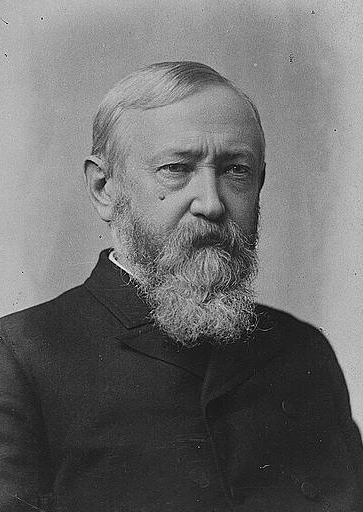
Number 23: Benjamin Harrison

Years in office: 1889-1893
Pre-service occupations: lawyer, Indiana supreme court reporter (elective office), general, U.S. Senator
Key events during his administration: Johnstown, Pa., flood (1889); first Pan-American Conference (1889); Sherman Anti-trust Act (1890); Sherman Silver Act (1890), Wounded Knee (1890), McKinley Tariff (1890); overthrow of Hawaiian monarchy and treaty to annex Hawaii (1892); death of first lady Caroline Harrison (1892); states admitted to the Union: North Dakota, South Dakota, Montana and Washington (all 1889), and Idaho and Wyoming (both 1890).

Presidential rating: Mildly successful and mixed on popularity

ESSAY

Here’s a difficult presidential quiz that you can try on your friends and family. The first question should narrow it down a little:

1) Who was the original trust buster?

2) Who struggled to get civil rights legislation passed?

3) Who was the true author of big government?

4) Who believed that the government had a responsibility to act for the public good?

This was a trick question, of course, and if you said Theodore Roosevelt or Abraham Lincoln to any of the answers, you’re wrong. There’s only one right answer: Benjamin Harrison (naturally, because you’re reading a review about him!).

Benjamin Harrison is probably the most “forgotten” of all the forgotten presidents. Sandwiched between Grover Cleveland’s two terms, sometimes confused with his more famous grandfather, and not celebrated in any way by the Republican Party, Benjamin Harrison seems like one of those people you are duty-bound to write or talk about just because he was president.

However, Benjamin Harrison was actually a decent president, one worthy of being remembered. The first half of his term was unusually successful—but that success helped doom him to defeat. He was not a towering figure in American politics, but he was an important player. Harrison was a strong Christian man who believed that a man should pay his dues—he never traded off his famous grandfather’s name, although the temptation was certainly there. He displayed excellent speaking skills, and used his oratory to secure a place in Republican ranks and set himself up as a thorn in the side of Democrats, whom he considered traitors.

Yet Benjamin Harrison had a reputation of something of a cold fish. Never a party favorite and always seemingly at odds with his secretary of state, the popular and ambitious James G. Blaine, Harrison did his presidential duty and then faded from history. What he helped set in motion, however, would reverberate over the next quarter century, making Benjamin Harrison a key, if not great, president.

Young Harrison
Benjamin Harrison was born in the shadow of greatness. His great-grandfather, Benjamin Harrison V, signed the Declaration of Independence and was a leader of Virginia during the rebellion against the Crown. His grandfather, William Henry, was of course the victor of Tippecanoe, hero of the War of 1812 and the 10th president of the United States. Young Benjamin, however, never acted as if he were royalty or anything special because of his lineage. Instead, he became infused with strong Christian beliefs that were to guide him his whole life.

For example, he grew up believing that a man needed to earn his keep and pay his dues. He never played off the name or fame of his grandfather—or even his own. Even after his term as president, he kept up his law practice. He also served as an elder in his church throughout much of his adult life. He believed wholeheartedly in living a godly life; the Lord was not far from his thoughts—or his actions. His public and private life were one and the same.

However, “stiff” would barely begin to describe Benjamin Harrison. One of the many nicknames given to him was “little iceberg,” and as you can imagine, it wasn’t flattering. Socially awkward and reserved, he nevertheless won the hand of Caroline Lavina Scott, whom he married in 1853.

Harrison struggled to begin a law practice in Indianapolis, where he won his first elective office. When war came, he joined the Union army as an officer and went into action in 1862.

The War
His service in the army mellowed him and made him less stiff. He raised the 70th Indiana Volunteers and saw some minor action in Tennessee and Kentucky before leading it and three other regiments in the Atlanta campaign. Harrison missed the March to the Sea, however, as he was called home to help ensure Republican victories in the fall elections. He later participated in the Nashville campaign and finished the war a brigadier of volunteers. But because of his time with Sherman in the campaign for Atlanta, he actually fought far more battles than Old Tippecanoe Harrison, his grandfather.

It’s also interesting to note that in 1864, Rutherford Hayes refused to leave the Army to campaign for the congressional seat he was nominated for (he won) claiming that anyone who did so “ought to be scalped.” Benjamin Harrison had a completely opposite understanding, believing that ensuring Republican electoral success was just as important as battlefield duty.

Rise of a faithful Republican
There is little to wonder at why Benjamin Harrison became a staunch Republican. Indiana was one of the birthplaces of the Republican party, and many of his grandfather’s beliefs seem to have found root with him as well, concerning duty and country.

He considered the Democrats either traitors or half-hearted supporters of the war, and oppressors of the free blacks. He believed that Republicanism was the true friend of blacks and labor. Why? Republicans had resumed specie payment, pushed a homestead act and, of course, freed the slaves and pressed for civil rights. His pre-presidential speeches rarely failed to emphasize the fact that Democrats were on the wrong (losing) side of the war.

His political career included serving as the Indiana supreme court’s reporter (an elective office), for which he proved diligent, and a failed campaign for nomination for governor. Indiana party leader Oliver Morton thought Harrison an arrogant aristocrat, but when the party’s nominee had to drop out, Harrison made a go and came within 1% of winning the governor’s seat. Later, when Senator Morton died, Harrison took his Senate seat. It was there that the Republicans found him when the time came to select a candidate for 1888.

1888: A suspect election
Benjamin Harrison became president at a time when stump speaking was still an art form. He was an excellent orator and certainly one of the best in the nation. He was frequently sought as a stump speaker, and spoke often around Indiana and the country for such Republicans as Hayes and Garfield, and later, himself.

Why was Harrison tapped for president? It wasn’t because of his grandfather, whose name Harrison never traded off of. Biographer Calhoun writes:

“It is impossible to know precisely when Benjamin Harrison began seriously to consider the notion that he could follow in his grandfather’s footsteps to the White House. After he had won the prize, he told a friend that ‘the thought had been with him many times when suggested by others, but he had never been possessed by it or had his life shaped by it.” (p.45)
It may have even been simple ambition. Regardless, by 1888, Republicans believed they could win the White House again from Grover Cleveland. The party had few prominent and nationally known fresh faces at this time, other than John Sherman and James G. Blaine, who still commanded attention and loyalty. Surprisingly, Blaine, a man would could rightfully be labeled the dean of the Republican Party, declined to run in 1888, leaving Sherman as the only heavy-hitter.

The Hoosier native saw his chance when Blaine decided not to run again. Harrison and his allies built upon his superb oratory skills and stance on the tariff—President Cleveland had made his entire 1887 address to Congress about lowering the tariff—voting rights in the South, and so on.

After numerous ballots at the convention, and with Blaine’s full backing, Harrison won the nomination. The tariff issue dominated the campaign, which featured Harrison conducting America’s first “front-porch campaign” wherein the candidate himself made numerous speeches on his own behalf at his Indiana home.

At this time, Calhoun writes, the two parties had achieved parity: both were pretty equal in terms of strength, and each had its strongholds, but it’s incorrect, he writes, to label this a Republican era because all but one presidents were Republicans. Congress changed hands several times, and the presidential votes were quite close, few more so than 1888.

For the third time in American history—and the second time in about a decade—the victor of the electoral college was not the man with the most popular votes. Harrison won the electoral college 233 to 168 while falling short by 100,000 popular votes to Cleveland. All well and good constitutionally—yet something wasn’t quite right. In fact, something really stank. Harrison attributed his victory to Providence, but a fraudulent voting technique called “block voting” in New York and Indiana, as well as numerous “favor” pledges made on behalf of Harrison—without his knowledge, it seems—sealed an election victory that might not have—or maybe should not have—happened.

Was Harrison elected by fraud? It’s not totally clear. Regardless, Cleveland did not challenge the election and neither did the Democrats. Harrison, unruffled by charges of fraud—after all, he was innocent, right?—went about preparing to do his duty. Four years later, though, the Clevelands would return.

The new president
While reading Charles Calhoun’s meaty biography of Benjamin Harrison, the 23rd president rose in my estimation out of obscurity into the ranks of decent presidents. This is partially because he had such a cussedly hard job to do as president. Once in office, Harrison, like every previous man to hold that position, was flooded with office-seekers—and also “requests” from state bosses and other powerful party men for positions either for themselves or favored sons as payment for services rendered during the campaign. It was a seedy side of politics, one which Grant made a valiant but doomed attempt to reform, and which Hayes, Garfield and then Arthur made some headway in fixing.

But running for president and actually being president are two different things. If you are a man of high character, as Harrison was, you don’t look on being president as (to use the modern term) being a big sugar daddy. Harrison did replace Democrat officials with Republican ones—as was expected, all crying aside—but he balked when it came to his cabinet. James Blaine, the very powerful Maine senator and de facto leader of the Republican Party, wanted the secretary of state’s office. But Harrison, wary of having the polished and refined dandy Blaine as a co-equal in the administration, waited for two months before offering Blaine the position at State. By doing so, Harrison was letting there be no mistake as to who was president and who was merely a cabinet member. Blaine got the message, but their friendship slowly eroded over the next four years.

So did Harrison’s support, because in trying to do the right thing amid the myriad of appointments, he unfortunately angered state bosses, who were not inclined to support him in 1892. They chose politics over the best for the nation, while Harrison, with Christ as his guiding light, chose the best for the nation over politics. And it cost him dearly.

The activist president and Congress
I laugh when modern-day libertarians and conservatives claim that Abraham Lincoln is the author of big government. Most of Lincoln’s measures were either wartime proscriptions that disappeared after the war or were Republican party platform measures that would have been enacted regardless of the war, such as the Homestead Act. Up until the final decades of the century, however, Americans largely looked askance at any intrusiveness of the central government. State control still reigned supreme (the Civil War aside) but more people began to realize that government needed to be larger by default and demanded that government take more action in more areas of people’s everyday lives.

For example, a dam burst caused much devastation and loss of life at Johnstown, Penn., in 1889. President Harrison appropriated federal funds for the town to rebuild (something his predecessor/successor Cleveland opposed) and the president received what could almost be termed a hero’s reception when he visited.

Mainly, though, the activism centered on business and economic concerns, what with labor and farmers demanding more control over their financial well-being, and freedom from the control of Eastern bankers and financiers. The social activism of black rights had faded from the forefront as a national issue after Reconstruction, Indian rights seemed to be fading as the frontier closed in, and women’s rights hovered in the background.

The Republican Party had drifted away from the “waving of the bloody shirt” associated with reforming the South and became tied more to business interests. It’s grossly incorrect to label the Republicans the party of big business during this era, especially because of how presidents from Grant through Harrison acted—and especially the 51st Congress of 1888-1890. The 51st congress, controlled by the Republicans and driven by the idealism of Harrison, was the most activist congress the Republic had ever seen. More than 500 pieces of legislation were passed into law. Biographer Calhoun writes that the activity was a shock on a nation used to a more placid government. And that very activism is what led to the Republicans getting creamed in the elections of 1890, losing control of the House by a huge margin.

That defeat was in the future, and Harrison enjoyed several legislative victories in his first two years, including the Sherman Anti-Trust Act, the Sherman Silver Purchase Act and the McKinley Tariff.

The first was the famous “trust-busting” bill (basically an anti-monopoly bill) that became associated with Teddy Roosevelt instead of Harrison, even though 12 suits were brought during the next two years under Harrison. The second was a sticky situation that was less of a victory and more of a troublesome compromise. It increased the amount of silver that the government bought each month—but the bill was far short of the free coinage of silver that Western silver backers wanted—silver being found in abundance in the West. Essentially what this meant was that government money was backed by both silver and gold, with gold in greater proportion to silver. But people turned their silver notes in for Treasury gold, which depleted government gold and led to the Panic of 1893. (See the previous entry on Grover Cleveland for much more on this debate and the Panic.)

The third was a big victory for Harrison—and for the next Republican president, Congressman McKinley—in that he had campaigned on protectionism. The tariff bill was passed in part because Republicans lent support to the silver act, and also in part a response to a very high Treasury surplus, which the new tariff legislation would eat away. The Republicans pledged to protect American manufacturers from “unfair” foreign competition, and a lower tariff was intended do much to protect business while easing the burden on the Treasury.

However, the silver and tariff bills wound up not helping the Republicans in the fall elections—particularly, I think, because Harrison’s longed-for civil rights bill was postponed—and the GOP lost seats. The civil rights bill, which never came to pass because of GOP seat loss, would have used federal authority to help secure black citizens the right to vote in the south. Harrison strongly believed that blacks had—and were even owed—a place at the political table, and he sought to secure their freedoms from the Southern governments, all controlled by Democrats. But his efforts unfortunately bore no fruit, and the failure to get a civil rights bill was a bitter disappointment.

The 1890 elections
As mentioned, the Republicans lost heavily in the fall elections, and control of the House transferred to the Democrats. The aforementioned activism greatly aided in Republican defeats.

Another, equally important reason why the Republicans lost was the president himself. Harrison’s negative reaction to the demands of appointments sullied his name among party leaders. Despite the reforms battle that had come to a head during Chester Arthur’s term, appointments remained the biggest way you “played to your base,” but Harrison was more interested in doing what was right for the country than what was right for the party. Consequently, both he and the party suffered for it. There was simply less enthusiasm and energy for the party in 1890 than there was in 1888. (Sounds familiar, doesn’t it.)

The 51st Congress’ session didn’t end until March 1891; so, there was more work to be done. But Harrison would not get his long-sought civil rights bill, however, due to a combination of financial crises (which Harrison and his Treasury secretary handled as well as the Federal Reserve would in the 20th century) and further agitation from the silver coin crowd.

When the 52nd congress came in, Harrison’s cherished civil rights bill died forever. Even Harrison’s attempts to try for compromise failed. Racist white supremacist Democrats and uncaring free-silver Western Republicans killed the bill over unfounded fears of a “new Reconstruction.” The aged Frederick Douglass, however, noticed and called Harrison a great president and friend of blacks (similar to comments he gave about Grant).

Blaine troubles
The first two years of the Harrison presidency seemed to be happier than the final two, with good reason (more on that later). But it seems that the Blaines, and another stalwart of Republican politics, Rockefeller, snobbishly looked down on the simple and pious Harrison and his wife, Caroline. Blaine also worked at cross purposes with his boss, even writing public letters against proposed or official policy and then privately writing his boss that he hoped he hadn’t said anything to upset Harrison.

I have developed a dislike of Blaine—the kind of politician I could really do without. He seems like a political snake—or at least a Machiavellian. I didn’t like him much on a personal level when I was reading the biographies on Cleveland, and I certainly don’t like him now. An important figure, certainly, and very competent, but a politician through and through.

International actions
Internationally, Blaine and Harrison worked together with England and Germany in what was America’s first foreign treaty of cooperation. America and the two European powers came to an agreement concerning portage rights in Samoa.

Harrison also presided (nominally) over the first Pan-American congress, which was the loving brainchild of his secretary of state. Blaine had originally conceived the idea of a conference of American nations to come together for peace and stability during his short term as Garfield’s secretary of state in 1881. He kept the idea going during the terms of Arthur and Cleveland—neither was interested—and he finally got the chance to revive the idea almost a decade later. This First International Conference of American States was held Jan. 20-27, 1890, but to his disappointment, it wasn’t what he expected it would be. The conference focused more on commerce and industry and less on avoiding war through mutual commerce and cooperation.

Even though the conference fell short of expectations, it nevertheless proved to be the starting point for the Pan American Union (PAU), which still exists today.

In Hawaii, a cabal of American businessmen, Europeans and Hawaiians who called themselves the Committee of Safety overthrew Queen Liliuokalani and established a new government. A treaty of annexation was sent to President Harrison, who, uneasy at first, sent it to the Senate. President Cleveland killed the treaty during his second term after learning more about what actually happened. (See the Cleveland entry for the full story.)

Massacre at Wounded Knee
In 1890, the last action of the Indian Wars took place, the battle or massacre at Wounded Knee, S.D. Harrison was continuing the policy that Grant first put in place to press for citizenship of Indians but punish those who committed crimes.

The real culprit in this sad episode seems to have been a corrupt Indian agent who made unfulfilled promises and also made great exaggerations regarding the “hostile” nature of the Sioux’s Ghost Dance. Harrison had been ordering caution and was reading Gen. Nelson Miles’ report on the situation when word reached him of the battle/massacre. Mainly, it seems like the it was a situation that just got out of hand, and the Sioux were more victim here than aggressor. The colonel in charge was brought to a court martial but was exonerated. The sad affair did not prompt any change in policy by Harrison. Calhoun writes that the president viewed it more as an unfortunate incident than the watershed event we now look on it as being.

End of the administration and loss to Cleveland
Harrison and his team successfully averted a cholera outbreak by halting immigration, but he received little praise for it. Instead, he lost support among immigrants over labor and immigration issues. Some I agree with, others I do not, like the continued banning of Chinese immigrants, begun by Cleveland. Harrison—unfairly—took hits over labor unrest.

Worse, Harrison’s actions in 1889 and ‘90 were now hurting. There was a movement to make the ailing Blaine the nominee, and state bosses and bigwigs were not too thrilled with Harrison over appointments. Blaine and Harrison fell out—Mrs. Blaine was open with her contempt, even hatred of Mr. and Mrs. Harrison—so that when the “draft Blaine” movement gained strength, Blaine finally resigned from State. Curiously, Harrison did not pull out all of the stops on securing the nomination until two weeks before the convention. When he finally did, he only got 60% support. The remaining 40% of the delegates split their support between Blaine and McKinley.

Cleveland, on the other hand, easily secured the nomination. Democrats were ready this time around, and made alliances with the Populists and even free-silver Republicans. There wasn’t much enthusiasm on the Republican side, and Cleveland won.

But probably the biggest factor (which Calhoun doesn’t go into that much) was that the standard bearer himself was absent. Caroline Harrison had been sick throughout much of 1892 and had finally been diagnosed with tuberculosis. Harrison avoided all campaigning, preferring to remain with his dying wife. She succumbed in late October, two weeks before the election. How in the world could a man campaign under such a circumstance? He couldn’t, and he didn’t. (Cleveland halted his campaigning out of respect.)

Still, Harrison left office believing (correctly, I might add) that he had done the best possible job he could, and that his administration had served the public interests well. He did leave with a black eye, though, over the shameful coup in Hawaii. It is highly unlikely that Harrison had anything to do with it, but he nevertheless approved that it had happened and sent annexation papers to Congress. Nothing happened on it, though.

After leaving the White House, Harrison returned to Indianapolis, where he resumed his law career.

He then married a widow, Mary Scott Lord Dimmick, in 1896. She wasn’t just any widow, but Caroline’s niece and his longtime pen-pal confidant. Many in his family didn’t approve of the marriage.

In 1899, he attended the First Peace Conference at The Hague. He died in 1901.

Final assessment

Benjamin Harrison was a president who served with honor. He’s “forgotten,” but he and the 51st Congress set some things in motion that, in a way, we’re still dealing with. A tremendously activist central government came out of his presidency. It was still a far cry from the almost wholesale reordering of the relationship between government and governed during the FDR years, but nevertheless, American government began to change in a fundamental way during the Harrison years that’s only now beginning to be understood.

I don’t want to oversell Benjamin Harrison or this change, however. To get an idea of the change, imagine if you were expecting an inch of snow and you get four inches instead (as opposed to expecting a dusting and getting a blizzard).

Writes Calhoun:

“Benjamin Harrison had not set out to transform the presidency, but he was hardly a mere caretaker between the two terms of Grover Cleveland. In his own right, Harrison made important contributions to the office. He entered the presidency strongly committed to a set of principles and policies. In defense of those ideas and in pursuit of what he thought to be his duty, he expanded the boundaries of presidential activism. Both publicly and behind the scenes, he effectively intervened in the deliberations of Congress and posted a remarkable record of legislative achievement. He resisted the dictation of party bosses in the matter of appointments, thereby risking his own reelection for the sake of presidential independence. He frequently operated as the nation’s chief diplomat and shaped its aspirations in foreign affairs. Through skillful use of the press and in widespread travels, he took the presidency to the American people.” (p.165-166)

Indeed. Fellow Republican McKinley learned many lessons from the 23rd president, and used them to good effect as the 25th president.

Resources

Charles Calhoun’s study on Benjamin Harrison for Schlesinger’s American Presidents series proved most illuminating. The casual reader could easily get lost in discussions of policy, especially the nebulous realm of tariffs. And it may seem that knowing President Harrison is perfunctory merely because he was a president. However, that attitude does him a disservice.

The Presidency of Benjamin Harrison by Homer E. Socolofsky and Allan Spetter, 1987, from the University of Kansas’ The American Presidency series is also useful for understanding not only Harrison’s term, but also the near 50-50 politics of the Cleveland/Harrison era.

The illustration is taken from the Library of Congress' Prints and Photographs division.

Sunday, February 3, 2008

Numbers 22 and 24: Grover Cleveland

Years in office: 1885-1889, 1893-1897
Pre-service occupations: attorney, sheriff, mayor and governor
Key events during his administrations: 1st term: veto of pension bills, Geronimo campaign (1885-86), Haymarket Riot (1886), Interstate Commerce Act (1887), Dawes Act (1887); 2nd term: Chicago Exposition (1893), Panic of 1893, Pullman strike (1894), rejection of Hawaii annexation and subsequent recognition of the Republic of Hawaii (1893-1894), repeal of Sherman Silver Purchase bill (1893), J.P. Morgan gold purchase syndicate (1895), Olney Interpretation (1895), Utah admitted to the Union (1896)

Presidential rating: First term: Mildly successful and mixed on popularity. Second term: mildly unsuccessful and unpopular

ESSAY

He’s been called unfailingly honest. A dull speaker. The “Buffalo Hangman.” A man above party.

Grover Cleveland was all that and more. The 22nd and 24th president was unique in more ways than one. First, and most obvious, he was the only non-consecutive two-term president. Second, was the only Democrat elected president between 1860 and 1912. Third, he was the only president during the last half of the 19th century to not serve in the Civil War. And fourth, before Franklin Delano Roosevelt, he was the reigning champion for winning the popular vote in presidential elections, in 1884, 1888—when he lost the electoral vote—and 1892.

Of course, there’s far more to the man, and there’s a lot I like about him. Cleveland has undergone something of a reassessment of late, and one thing floats to the top that many historians like: his unfailing honesty. That honesty, which his contemporaries acknowledged and admired, elevates Cleveland to the upper tier of presidents.

Understanding Grover Cleveland is not easy. For decades, writes biographer Richard E. Welch, historians though they had him pegged as the paragon of political honesty amid a sea of Gilded Age corruption and a political wasteland. Later reassessments removed Cleveland closer to the bottom of the heap, as he was labeled a “Bourbon” Democrat who deserved scorn for failing to live up to those historians’ new theories on the social and political movements of the era. For example, Cleveland was no supporter of suffrage (women’s voting rights), but few other people were, either. Cleveland needs assessing by the terms of his own era.

Nowadays, Cleveland is enjoying a reassessment that more or less places him back where he started: an honest, often contradictory and practical man who took things as they came.

President Cleveland foreshadowed the coming progressive movement in words, if not in actual deeds. He was tightly frugal with the public’s money and believed in, to use the modern cliché, a level playing field. Companies and barons that horded most of their profits without elevating those who brought them the profits earned his particular scorn. But likewise, he refused to place people under the government’s charge, believing that the people supported the government, not the other way around.

He was the last president to take a largely hands-off approach to most aspects of national and public life, fully embracing the original concept that the president was the nation’s chief executive, meaning he was the executor of the nation’s laws and policies. His administrations bracketed the first truly activist presidency (Benjamin Harrison’s) and was, in some ways, a fitting coda to the 19th century. A man of deep principle and privacy would soon be forced to give way to nation demanding much more from government, much more from media and much more from the president himself. Yet at the same time, Cleveland continued the expansion of executive power in subtle ways.

Cleveland, it can be said, was the last of the old guard while simultaneously being the first of the new guard.

The rise of a “Bourbon” Democrat
Stephen Grover Cleveland, born in 1837, stopped in Buffalo when he was 17 looking for work. His father had died recently and he needed to help support the family. His uncle, Lewis Allen, was influential in Buffalo and introduced him to a career in law. The young Cleveland took a clerkship, read law and was admitted to the bar in 1859. (The firm Cleveland joined was Rogers, Bowen, and Rogers. Previously it was known as Fillmore, Hall and Haven, and is known today as Hodgson Russ LLP, the only firm in the country that can boast of having had two presidents as partners, the other being Millard Fillmore, of course.)

Meanwhile, Cleveland entered the politics of the Democracy (as some referred to the Democratic Party back then) in his native New York when he was 19. He campaigned for James Buchanan and ran for his for office in 1865—and lost. His uncle was a staunch Whig, but Cleveland believed firmly in the ideals of the Democratic Party, especially his ideological heroes, Jefferson and Jackson. He would eventually become associated with the “Bourbon” Democrats (See: Explaining the Cleveland approach to government), especially after his terms as president.

He remained at his law practice during the war until January 1863, when he accepted the post of assistant district attorney for Erie County. When Cleveland received a draft notice in 1863, he hired a replacement to fight in his stead. In 2008, such a move would have been political suicide, but Cleveland would suffer politically only partially for not wearing the uniform, and then only after he became president the first time. His strength of character and a combination of events—and different times—was more than enough to override such concerns.

Cleveland was a playful young man who liked the outdoors. He frequented pubs and taverns, relishing good food and good beer. The pubs and taverns, though, were not just places to satisfy his thirst and hunger: before the age of mass communication, they served as the meeting places for political meetings. Young Cleveland whet his chops on more than just beer and mutton at these places: he’d stand on a crate or barrel and speak his political mind to would whoever listen. And listen they did. He wasn’t a great stump speaker, but—to use the word most often applied to him—Cleveland was an honest one.

His single-minded devotion to whatever tasks were set before him led Cleveland to be elected to his first office in 1871: sheriff of Erie County, which includes Buffalo.

A fast track from hanging judge to presidential nominee
Many people today look for “experience” on the resume of presidential contenders. On paper, Grover Cleveland had an impressive resume: A lawyer, sheriff, mayor of Buffalo and governor of New York. Sounds good. However, the future president wasn’t in the elective positions for a relatively long period of time—at least by the modern understanding of “experience.”

He served as sheriff, mayor and governor for one term each. But in each of those terms, Cleveland earned—truly: earned—a reputation for honesty and strength of character and devotion to duty that was astounding. During his term as sheriff, Cleveland executed two condemned criminals himself. Later, political enemies tried to sneer at the “Buffalo Hangman,” but Cleveland, nonplussed, explained he wouldn’t have anyone do something he couldn’t do himself.

In 1882, Buffalo elected him mayor. “Public office is a public trust” was his campaign slogan, and he proved true to his word. His reputation for honesty and trustworthiness with the public’s money and public responsibility took root during his mayoral service, through such actions as refusing to award contracts to the highest bidder, instead of the lowest bidder. He took on the local machine politicos and won.

The next year, his fame as Buffalo’s mayor elevated him to the governor’s mansion. He defeated an ally of President Arthur for the office—exposing major weaknesses in the Republican Party’s New York machine—and proceeded to operate the same way as governor as he had as Buffalo mayor.

Governor Cleveland had embraced the reform sweeping the nation, but not wildly so. His approach was practical: reform, but with limits that would not totally destroy the political structure. Biographer Henry F. Graff explains:

“In addition to being morally offended by the excesses of the spoils system, Cleveland understood the change in the requirement of government in the 1880s. The political tradition that “to the victor belongs the spoils” was plainly out of date and had to be abandoned. Still, Cleveland was not unmindful of the need to nourish the political parties, but in his appointments he balanced as honorably as he could the demand for both party loyalty and professional competence. For example, he appointed the assistant in the insurance department to be its director. In filling the ranks of the Railroad Commission, Cleveland chose so carefully that it became a judgment on his stewardship that as well as a feather in his political cap that New York State had less organized hostility to the behavior of the railroads than any other state in the Union.” (p.36)
Balancing the needs of party and competence was but one of many good marks he carried into the presidency.

It is noteworthy that a Cleveland ally in the New York legislature was a young Republican named Theodore Roosevelt, who approved of Cleveland’s conservation efforts at Niagara Falls and words against corporations.

Cleveland’s term as governor was cheered throughout the state—except the anti-reformers of the old Boss Tweed’s Tammany Hall, taken down by one of Cleveland’s predecessors, Samuel Tilden, and, of course, by many of the Republicans. But not all: Some Republicans grudgingly admitted that Cleveland kept his promises and did what he said he would do.

National party leaders took note of this newest New York governor as a strong contender for the 1884 election.

The election of 1884; or, how to handle a scandal
Republicans and Democrats put fourth platforms in 1884 that were remarkably similar: they both favored protective tariffs, they both favored a stronger currency backed by gold, they both favored limits on immigration (especially the Chinese). Both parties even held their conventions in the same hall in Chicago, two weeks apart. The election, therefore, turned on personality—and ugly campaigning.

Republicans were for once without a truly nationally appealing candidate who could unite all factions of the party. President Arthur made only a halfhearted attempt at the nomination. Grant was ailing and would be dead the following year. The promising meteor Garfield was dead. Roscoe Conkling had greatly overreached and was gone, and his Stalwarts were fading. Famed Union general William T. Sherman told the party to take a hike, famously remarking “If nominated I will not run. If elected, I will not serve.” That left James G. Blaine of Maine, last seen as Garfield’s secretary of state. Blaine wanted the nomination, and after beating back Arthur’s half-hearted attempt, won the nomination.

Although a forceful personality and full of vision, Blaine turned off enough Republicans who defected to the Democrats. These “mugwumps” would not vote for the “corrupt” Blaine, who had been accused of shady railroad funding (that had derailed his previous run for the presidency in 1880). Although Blaine was a strong and talented man, his candidacy bore the flavor of so many men who run for the presidency on their party’s ticket because it is “my turn.”

Cleveland won his nomination after his supporters beat back an anti-Cleveland attempt, but the outcome was not seriously in doubt. However, his was a fresh face—literally in one way, because Cleveland did not have a beard. (Of the presidents from 1860 on, Grant, Hayes, Garfield and Arthur and Harrison sported full whiskers; Johnson and McKinley were clean-shaven. Lincoln had only a beard while Cleveland had only a mustache. William Howard Taft would be the last president to have any kind of facial hair.)

The campaigning is where things got interesting—more specifically, when supporters and sympathetic press began making speeches, marches and running editorials. This was still the era when candidates usually didn’t themselves campaign, but Blaine was an exception. He made hundreds of speeches that summer and fall. Cleveland ran his campaign from his home in Albany. Cleveland wasn’t even at the convention.

Shortly after the Democratic convention in early July, a Buffalo scandal sheet ran a story claiming Cleveland had fathered a child out of wedlock, the child had been sent to an orphanage and the mother was in an asylum. When a respectable paper ran with the story, Republican press and supporters immediately pounced on the story as proof that “honest” Cleveland had no morals and was unfit for the presidency. Republican rallies were soon filled with baby carriages and the chant, “Ma, ma, where’s my pa? Gone to the White House, ha, ha, ha!”

Rather than deny the charges, Cleveland said simply, “Tell the truth,” which has become the gold standard for dealing with scandal. The “truth” was very close to what the rag had printed. Cleveland had had an “intimate” relationship with Maria Halpin, but it was not known who the father was. Apparently, his married law partner, Folsom, may have also had relations with the woman. When she turned up with a child, Cleveland assumed financial responsibility both to do the right thing and to prevent any possible embarrassment for his partner. When Halpin developed a serious drinking problem, however, Cleveland had her committed and the child sent to an orphanage—whose expenses he continued to pay.

Cleveland made a smart move, because by owning up to what was going on, he negated a lot of the charges’ impact. He was, however, completely humiliated and angered by the intrusion into private affairs, and also angered at his treatment by certain people in Buffalo. He rarely returned to the city after that.

The campaign remained close until the end, when Blaine failed to counter a New York preacher speaking on his behalf against the Mugwumps as not real Republicans for joining the party of “rum, Romanism and rebellion” (e.g., the Democrats). The perceived slur against Irish and Catholics made it seem as if the Republicans were once more waving the bloody shirt, biographer Graff writes, and it made sure New York went for Cleveland. At that time, if you won New York, you won the presidency, too. Graff says it’s not known how many votes switched because of the fabulous flub, but it was enough.

Cleveland won 219 to 182 electoral votes and by a mere 20,000 popular votes.

Gleeful Democratic editors now had an answer to “Ma, ma, where’s my pa”: “Hurrah for Maria! Hurrah for the kid. I voted for Cleveland, and I’m damned glad I did.”

Explaining the Cleveland approach to government
Cleveland would eventually be known as a “Bourbon” Democrat—in fact, the term is closely identified with him more than anyone else. The oddly named Bourbons supported business interests, opposed the protectionism manifested in the high tariffs, supported railroads, opposed imperialism, supported sound money (gold standard) and opposed bimetallism (free silver). But as we’ll see, the term Bourbon Democrat doesn’t quite fit with Grover Cleveland.

As alluded to earlier, Grover Cleveland believed that the president’s primary duty was to execute the legislative branch’s laws, but he also believed that the chief executive, being the only official elected by all the people, needed to curb the excesses of the Congress. He freely used the veto to slap down—often unsuccessfully—bills that went against what he believed constituted the government’s true functions.

No deep thinker or theorist, Cleveland instead was a pragmatist who approached issues one at a time. He sometimes contradicted himself, a tendency which added to his reputation of being “above party.” Toward the end of his second term, this caused great distress in his party, because he believed he was right and those with different views were at best wrong and at worst party heretics. He talked a great game about fighting corporations and monopolies in favor of the common man, but critics charged that he was a faithful ally of those same business magnates. The appearance was deceiving, because while the president was not an adherent to laissez faire (despite the label of Bourbon Democracy), he was a firm believer that the federal government should not have any favorites. In fact, during a veto message in 1896, biographer Welch explains that Cleveland wrote that the federal government’s purpose was “the enforcement of exact justice and equality” and not to spread favors to one group or another. (p.14) Welch further explains:


“A consistent theme throughout both administrations…was his conviction that governmental paternalism could only encourage a dangerous dependence on the federal government, destroy the American tradition of local charity and self-help, and undermine the independence and therefore the virtue of the citizenry. Governmental paternalism could, indeed, erode the very foundations of popular government if ever the electorate could see the government not as an instrument of their creation demanding their loyalty but as a source of gifts and privileges. Paternalistic government could only change the relation of the citizen to the government: instead of being a sovereign, the citizen would become a dependent.” (p.13-14)
Cleveland’s ideological heroes, Thomas Jefferson and Andrew Jackson, would probably agree. Cleveland, however, often seemed to draw on Jefferson’s polity principles when needed and Jackson’s strong-armed executive when needed. For example, the president certainly changed his mind between his first and second administrations. During the first term, Cleveland adhered to the 1884 Democratic platform, which called for less centralization and more state sovereignty. Yet during the second, he willfully used federal soldiers to break the Pullman strike over the strong objections of the Illinois governor—asserting executive authority to perverse law and order. Welch explains:


“Like his hero Andrew Jackson, Cleveland could simultaneously speak against the centralization of power in the federal government and expand the power of the federal executive. Cleveland’s interpretation of the traditions of the Democratic Party was, at the least, flexible. He quoted Jefferson when denouncing federal interference in local elections, but acted like Jackson when he overrode Governor Altgeld and claimed supremacy for the federal government and its chief executive during the Chicago railroad strike.” (p. 147)
In simpler terms, Cleveland took a little from column A and a little from column B and produced what could be termed Cleveland Democracy.

It would certainly be odd to find Grover Cleveland celebrated in today’s modern, liberalized Democratic Party, considering he opposed the very mentality the party now stands for. In fact, Welch relates how in 1979 JFK intimate Arthur Schlesinger, Jr. argued that “conservative” President Jimmy Carter should be dumped in favor of liberal Ted Kennedy, using Cleveland as a Carter archetype!

Modern conservatism, though, should find much to admire in some of Cleveland’s anti-paternalism beliefs.

The first term begins
With the Democrats back in the White House for the first time since 1857 (the Andrew Johnson aberration notwithstanding), the Democrats were naturally eager to take their share of what for so long had been denied: federal appointments. The fitful civil service reforms of the previous administrations had changed only so much, and Democrats wanted—demanded—offices.

Cleveland wanted to put the best men possible in all available posts. The trouble was, Graff explains, the quarter-century Republican run on the presidency conversely produced a dearth of Democratic talent in high government places. Cleveland wound up recruiting cabinet and other officials from business and railroad interests (while inadvertently snubbing some old friends) and from the party. Two were former Confederates, appointed in part to be a symbolic gesture of a healed nation.

The result was a respectable, if not outstanding, cabinet. However, it contained no representatives from laborers, farmers and others on the lower end of the political, social and economic spectrum. While that may seem like a modern-day, squishy multi-cultural lament, it proved to be an oversight, because President Cleveland would prove to have something of a tin ear when it came to matters that concerned the agrarian Midwest, South and West.

President Cleveland soon ran afoul of the self-anointed reformers, who demanded a justification for every dismissed officeholder. The “justification” was simple enough: they were Republicans and Cleveland was a Democrat, and now the Democrats were in office and Cleveland was doing what had been done since the age of Jackson. The President ignored the reformers’ demands, though, and he actually made fewer office changes than his predecessors (who were all Republicans).

Cleveland’s vice president would not last the term: Thomas Hendricks, who had been Samuel L. Tilden’s running mate, died in November 1885.

The vetoes and the railroads
President Cleveland began exercising his right to veto legislation almost at once. It’s possible that a more eloquent president, or a man who had the advantage of modern mass communications, could have better explained himself, because some of his vetoes would cause him unnecessary woe. For example, he vetoed hundreds of pensions for Union veterans, most of which were put fourth by northern and western congressmen as favors for people in their home districts. Many of the bills were frivolous. Cleveland denounced the pensions as raids on the public treasury. He also vetoed Congress’ bill granting a pension to all Union veterans for disabilities not stemming from the Civil War. Southerners didn’t care, naturally, but many Northerners were furious at the Democrat Cleveland, a man who hadn’t served, denying the benefits (and with sometimes sarcastically worded veto messages)—even though he was technically right.

The president, however, did not just veto pension bills and relief bills to farmers whose crops were ruined by drought. He struck down any bill he believed contained measures and funding arrangements not authorized by the Constitution—as he believed was his duty. The “little guy,” so to speak, was not the only one to feel the wrath of Cleveland. The president targeted railroads for investigation of fraud for holding onto government land grants that they never used. This land was ripe for settlement and, Cleveland and his Interior minister argued, was rightfully the government’s.

Angry railroad investors complained, albeit fruitlessly. In all, 81,000,000 acres of land grants returned to government control—equivalent to the size of New Jersey, Delaware, Maryland, Virginia, Pennsylvania and New York, if put together in one lump.

But Cleveland was not done with the railroads, and neither was Congress. Finally responding to longstanding complaints from westerners, especially farmers (who were organizing into “Granges”), Congress created and Cleveland signed the Interstate Commerce Act in 1887, which also created the Interstate Commerce Commission, the first true regulatory agency in American history. The ICC’s specific mission was to regulate prices on the railroads and eliminate abuses and discrimination in hauling freight and passengers.

Haymarket
Although a welcome addition on the Plains and in the west, the ICC didn’t exactly endear Cleveland to non-Eastern Democrats. Nor did he help himself much with labor relations during his first term, mainly because of his “no favors” philosophy.

For decades, the laboring, wage-earning class had been growing in numbers and growing restless. By the mid-1880s, there truly seemed to be a clear dividing line between the haves and have-nots. The great strikes of the summer of 1877 during President Hayes’ term were just the beginning. In 1885, the American Federation of Labor formed under the leadership of Samuel Grompers.

In May 1886, tensions in Chicago literally exploded when a bomb was thrown into the midst of police marching to break up a peaceful meeting of strikers, which had just ended. A policeman was killed and they fired on the crowd. More people were killed and many more injured in the subsequent Haymarket riot.

Haymarket would, in a way, provide the rallying cry for the 8-hour work day. Cleveland played no role in the chaos in Chicago—this time. The next time Chicago witnessed chaos and bloodshed and strikes, Cleveland sent in the troops.

Geronimo campaign and the Dawes Act
The second-to last great campaign in the west came during Cleveland’s first term. Chiricahua Apache led by Geronimo (or Goyaale) resisted government attempts to enforce reservation life. Apache lived in the New Mexico and Arizona territories. For a while, Geronimo and his followers acquiesced to the entreaties Gen. George Crook and lived on a reservation for a short while. But they broke out again in 1885. Crook was replaced with Gen. Nelson A. Miles—the same general who had fought the Nez Perce.

President Cleveland authorized a major campaign against Geronimo. In 1886, Miles did just that, using up to one-fourth of the army to capture the Apache and his few dozen followers. A Lt. Charles Gatewood negotiated a peace where the Apache would be transferred to a Florida reservation. (Miles, in one of the most dishonorable actions of the 19th century army, shipped Apache Army scouts off with the Geronimo renegades too.)

The Geronimo campaign mattered little as far as Cleveland’s presidency was concerned, for he would miss the final “battle” on the frontier. His successor/predecessor Harrison would bear that ignominy.

On a different note, Congress passed the Dawes Act in 1887 that authorized President Cleveland (and his successors) to survey and allot tribal lands to individual native families. The overall effect of this short-sighted act was negative, as it wound up costing many tribes and families their lands. It was actually a good deed attempt (possible noble, but I wouldn’t go that far) that just wasn’t thought through.

Foreign policy—first term
President Cleveland’s foreign policies during 1885-1889 were benign and isolationist. He had no intention of involving the United States in the European powers’ game of gobbling up colonies. He backed away from the “entangling alliances” of involvement with England and Nicaragua over a canal and a treaty with Berlin over a trade agreement in the Congo.

The president, though, foresaw the need for a better navy. Building upon what Chester A. Arthur started, Cleveland and Navy secretary William Whitney pressed for continued modernization of the navy. Cleveland had no aggressive designs for the navy; however, his modernization program would greatly assist his second successor’s aggressive use of said navy.

He also sought appropriate coaling stations for ocean-going squadrons, especially in places like Hawaii—a place that would figure prominently in his second term. The navy buildup would more or less continue through McKinley’s terms.

The tariff battle
In keeping with his nature of being against a government of favors, President Cleveland urged Congress to reduce the protectionist high tariffs. In a highly unusual step for a president, he devoted his entire third annual message to Congress (in 1887) to the issue. He directly confronted Republicans and protectionist Democrats in blunt language, warning that disaster was pending and the blame would rest with Congress if it didn’t act.

Cleveland charged that “When we consider that the theory of our institutions guarantees to every citizen the full enjoyment of all the fruits of his industry and enterprise... it is plain that the exaction of more than [the minimal amount of taxes] is indefensible extortion and a culpable betrayal of American fairness and justice.” Therefore, the high tariffs had to go. Besides, he argued, the high tariffs prevented foreign competition, and lower tariff would satisfy business and labor alike by making raw materials and finished products cheaper, thereby opening more markets and making labor happier.

Cleveland was correct in his pointed, if caustic, assessment. Like his immediate predecessor, Arthur, he believed the high tariff was bad news for the economy and the country. Cleveland did not persuade Congress, and a reduction bill failed to pass. The Harrison administration and Rep. William McKinley would tackle the tariffs, but not in a way Cleveland approved. When the Panic of 1893 hit, Cleveland’s warnings seemed to have come true.

A White House wedding—and a meddlesome press
Grover Cleveland, as we have seen, was a workaholic who rarely took breaks. Occasionally he and a companion would go fishing, although on one occasion he made the political mistake of doing it on Decoration Day.

The old cliché of “love at first sight” bears real weight for Grover Cleveland. In a tale too strange for fiction, Cleveland loved his future bride from when he first set eyes on her as a baby. Frances Folsom—his partner’s daughter—was more than two decades his junior, a fact he was painfully conscious of.

But the socially awkward Cleveland came to love Frances—Frank, he called her—as she grew to young womanhood. When his partner died and he took his widow and Frances under his care, his love grew stronger until finally, in 1886, they were married in the first and only wedding ceremony held in the White House.

The Clevelands took a holiday in western Maryland where, to his dismay and disgust, the press easily found them the next morning. The president decried the reporters’ “colossal impertinence” for intruding on his honeymoon, but as Graff writes, was helpless to do anything about it (p. 80). The opulent tastes of Chester A. Arthur had given reporters a thirst for the private lives of presidents that wasn’t easily slaked. And the intrusion into the Clevelands’ happy moment was but the first of countless unwelcome media impositions that in a later age would be justified under the catch-all phrase, “the right to know.”

However, Cleveland wasn’t blameless before reporters. He bore a grudge against the media because of the whole Halpin mess, and he maintained an aloof stance from honest reporter inquires. Consequently, his image suffered. Never a brilliant communicator, Cleveland eventually turned off even friendly media in his second term.

1888 and defeat—for the moment
Grover Cleveland felt confident going in to the 1888 election. But in an odd twist, for the third time in American history the man who won the popular vote was not the same man who got the most votes in the electoral college. (The two prior occasions were in 1824 and 1876, both of which were decided in the House under much different circumstances.)

The Democrats quickly renominated Cleveland at the convention in St. Louis. The Republicans nominated Benjamin Harrison, grandson of the former (and short-lived) president.

By now, politics had become the national pastime. Although the duotone had yet to transform media and pictures were still rendered via gorgeous woodcuts or color lithographs, images of the Clevelands and the Harrisons appeared everywhere on trinkets, souvenir items, broadsides, and so on. Pictures of Frances were particularly favored—no great surprise.

Cleveland and the party ran a “disjointed” campaign, full of “lifeless leadership,” according to Graff. He was also prey to a dirty trick by an ally of the Harrison campaign, where a man posing as “Muchison,” a former English citizen, wrote to the British ambassador in America who he would suggest supporting in the coming election. The ambassador said Cleveland was probably the best as far as England was concerned. The phony “Muchison” published the letter, and it apparently had the same effect on New York as the “rum, Romanism and rebellion” crack had on Blaine’s campaign four years earlier.

Cleveland lost New York and Harrison barely eked out an electoral victory over the president, who nevertheless won more than 90,000 more votes than Harrison. There is some evidence that fraud may have helped Harrison win, too. Cleveland was nonplussed, and bowed to the electoral defeat. Francis Folsom told White House staff that they would return in four years.

The Clevelands retired to New York City, where the ex-president finally relented and lent his name to a law firm. In exchange for the prestige of his name, Cleveland indulged in his favorite pastime: work. Although the happy couple were by no means wealthy, they were comfortable. During this interim period, they began having children, including Ruth, who, according to some accounts, was the inspiration for the Baby Ruth candy bar (others claim that baseball hero Babe Ruth was the source).

Cleveland watched the events of the Harrison era with dismay and also the grim satisfaction that he believed he was right. Harrison, while not exactly an anti-Cleveland, approached government differently, and with a willing Congress, promoted an activist federal government. Harrison approved pensions for all Union veterans, approved “pork-barrel” bills and other things Cleveland abhorred—especially the highest tariff in American history. The McKinley Tariff, passed in 1890 with President Harrison’s support, helped the Democrats in the fall elections. That, and Harrison’s dealings with his party and fractured relationship with his secretary of state, James G. Blaine, made Democratic prospects seem rosier in 1892.

Biographer Graff writes (p.100) that it’s not entirely known whether Cleveland decided to throw his hat in the ring in 1892 out of a desire for political vindication, a need to finish his work as president or sheer boredom. Regardless, he began making speeches again in 1891 to various clubs and organizations on economic issues, and emerged as the party favorite to win back the presidency.

1892
Ex-president Cleveland made history in 1892 by becoming the first—and so far, the only—former president to run and win a non-consecutive term to the White House. (Note: only Jimmy Carter and George H. W. Bush could do so as of this publishing. Bill Clinton and G. W. Bush are prevented from serving again by the 22nd amendment.)

Cleveland won his nomination rather handily, while President Harrison, though seeming damaged goods, easily won re-nomination despite a challenge from Blaine. The campaign that year centered on the tariff as well as hard money versus silver. In another close election, Cleveland defeated Harrison 46% to 43% of the popular vote and 227 to 145 electoral votes (a Populist party candidate took 8% and 22 electoral votes).

I’ll say much more about this election in my write-up on President Harrison, because the reasons for the election’s outcome have more to do with Harrison’s defeat than Cleveland’s victory.

Regardless, Fannie’s words to the White House staff four years earlier had come true: The Clevelands were back.

The second term—not the same as the first
President Cleveland’s second term had a much different flavor than the first. He was still the same man—men of his character don’t change—but the country had shifted in his four-year absence. The tariff was still a major issue, what with the McKinley Tariff pushing levels even higher. But dirt farmers and laborers were better organized and wanted much more than the power-brokers of the East were doing. He might argue for sound money and the gold standard, but backers of “free silver” would soon find a ready target in the president. The Progressive movement was starting to take baby steps, but Cleveland would not be joining the movement.

The president appointed a cabinet that had no members from the first. This time, he found a post for an old friend from New York, Wilson Bissel, naming him postmaster general (Cleveland had inadvertently snubbed him the first time.

Early in his second term, the newspaper-loathing Cleveland had an operation on board a boat in the middle of the Potomac, done in secret to avoid turmoil in the markets. The president had contracted cancer in his mouth. The operation was a success, although part of his jaw had to be removed. A second operation was done to attach a prosthesis, and no one was the wiser until the secret was revealed after his death.

Panic
The second Cleveland administration was in trouble almost from the start, thanks to the severest depression to ever hit the nation (yet). The agricultural sections of the nation had not really recovered from the last depression in the 1870s—giving rise to the Granger movement and feeding into the Populist and fee-silver movements. The nation’s banking system was woefully inadequate. The McKinley Tariffs also appeared to be having the opposite affects, with some imports—and import revenue—declining. And Harrison administration largess didn’t help matters, either. Plus, American gold was flowing into Europe, which was experiencing its own market crisis.

The declining supply of government gold triggered the collapse. The Sherman Silver Purchase Act, passed during the Harrison administration, required the government to buy more silver for backing currency—using gold that was now dwindling. The Panic began in early May when the National Cordage Company went bankrupt followed by the fall of several stock prices the following day. Welch writes that:
“Banks began to call in their loans, credit dried up, and business failures increased week by week. Depositors withdrew their money from state and national banks, six hundred of which closed their doors, a majority of them in the West and the South. Railroads proved particularly susceptible to the financial panic. Before the year was over, The Philadelphia and Reading, the Erie, the Northern Pacific, the Union Pacific, and the Atchison, Topeka and Santa Fe railroads had been forced into receivership. They were joined in bankruptcy by fifteen thousand other businesses.” (p.116)

Unemployment totals rose to 20 percent that winter, the worst in the nation’s history up to that point. The worst hit were the agrarian regions, giving fuel to their rallying cry of free silver: the more silver-backed dollars, the more dollars would be printed. The more money in circulation, then the more dollars would be in their pocket because economic activity would increase. The president completely disagreed.

It’s interesting to note the different responses to severe depression enacted by President Cleveland and one of his successors, President Franklin Roosevelt. The latter’s response was to radically alter government and forever change the relationship between the citizens and the federal government. It is safe to say that Grover Cleveland would have been horrified at and condemned Roosevelt’s solutions to economic depression. Cleveland’s solutions were not to give fireside chats (he couldn’t have done that even if it were possible), put the nation back to work, create new government agencies and regulations and taxes, like FDR. Instead, his response was more like Grant’s: secure the nation’s credit and money supply.

Cleveland believed that the Panic was caused by unsound silver practices and the high tariffs, as well as a lack of business confidence in the government’s ability to meet its obligations. To fix the problem, he asked Congress to repeal the Sherman Silver Purchase Act, which it did by year’s end. But he couldn’t make gold magically appear in the Treasury. For that, he did one of the most unorthodox moves any president had ever done up to that time: he asked the private sector for a loan.

In 1895, the president approached his friend and one-time dining companion J.P. Morgan to create a syndicate that would supply the government $65 million in gold, including some from Europe, through the sale of $100 million in bonds to the public. Morgan and his partners made a killing, but the end result was a hefty gold surplus in the Treasury.

Cleveland was raked over the coals by many in the Democratic Party, the media and the budding Progressives for being in the back pocket of the “money trust,” which was pure baloney. Although he restored the nation’s money, he damaged himself in the eyes of the west.

Meanwhile, the president pushed Congress for a lower tariff. He wanted the McKinley Tariff gone, believing it to be one of the major causes of the Panic. Congress responded, but not entirely to the president’s liking. The resulting replacement tariff had hundreds of amendments attached to it, including a two percent income tax. Cleveland hated the bill and called it an abomination. He let it become law anyway, without his signature.

The nation began to climb out of the Panic in 1896. Politically, though, Cleveland took the blame.

The Pullman strike
The Panic sparked problems nationwide. None was more spectacular than the Pullman strike in Chicago in 1894. George Pullman, creator of the railroad passenger cars bearing his name, was a generous and paternalistic industrialist who built a splendid company town in what is now southern Chicago. He ruled it like a benevolent feudal master, though, and treated his well-paid employees almost like serfs. A large number of Pullman employees lived in this model town.

When the Panic hit and railroads started coming unglued, rail shipments dropped, causing the demand for Pullman cars to fall. Pullman cut wages by 28%, but workers complained that rents and costs in the company town weren’t cut as well, leaving them with little money. Pullman didn’t budge. Neither did employees: about 80% walked off their jobs in protest. Pullman then shut down all the factories.

The trouble would have remained in the Pullman family except many employees were also members of Eugene Debs’ American Railway Union. Word spread across the nation, and soon railroad workers refuse to handle any train containing a Pullman car. About 125,000 railroad workers in 27 states and territories struck. Railroads responded with strikebreakers. Although the strikes never reached the intensity of the 1877 strikes, they did lead to violence in some places. By July, only 10% of pre-strike rail traffic was getting into and out of Chicago. Railroad owners and the union blamed each other.

The impasse was broken when nationwide demands for action led to Cleveland’s attorney general, Richard Olney, obtaining a court injunction that forbade interference with federal mail. It was a strange injunction, though, because Olney, Welch explains, worked with the railroad managers’ group to not only break the strike, but also break the union. While a legally questionable collusion, the injunction went forward. If the mail was interfered with and private property was destroyed, federal soldiers would be used to restore order.

President Cleveland, who believed in law and order—recall that he was once the “Buffalo Hangman”—was not in not the Onley arrangement and was actually reluctant to use troops. But he would do it if necessary. And according to the injunction, it became necessary following a one-day riot south of Chicago; the federal attorney in Chicago wired that marshals could not enforce the injunction; only soldiers could. So, Cleveland sent in the troops—over the strong objections of the state’s governor, as previously noted.

Unlike the 1877 strikes, when President Harrison only sent in soldiers to keep the peace at the request of governors, President Cleveland sent troops to Chicago and other strike areas to break the strikes in collusion with business and regardless of the state and local governments’ wishes. Cleveland reportedly said that “If it takes the entire army and navy of the United States to deliver a postcard in Chicago, that card will be delivered," but the statement is probably apocryphal. Most governors sided with Cleveland—except Altgeld—and accepted his explanation that he did what he did for “the public safety.”

Labor, of course, thought that was hogwash, and probably never gave the president another look, even though Cleveland established a commission to study the Pullman strike in an effort to make recommendations on the federal government’s role in future management-labor issues. The commission made one interesting recommendation: a federal arbitrary panel, which Cleveland had recommended to Congress in his first term.

Hawaii
Hawaii, or the Sandwich Islands, as they were once called, had long figured into the designs of American presidents. During President Harrison’s last months in office, a cabal of Americans, Europeans and Hawaiians calling themselves the “Committee of Safety” overthrew Queen Liliuokalani and established a new government. (It’s a long story: see here for a neutral account). President Cleveland sent a former congressman named Blount to investigate what happened.

Blount concluded that the overthow of Liliuokalani was quite illegal, and that the U.S. minister and even American soldiers had acted wrongly. In response, President Cleveland withdrew from the Senate the treaty annexing Hawaii (placed there in the waning days of the Harrison administration). He offered to return Liliuokalani’s throne in exchange for amnesty for the members of the coup, but the queen refused, and reportedly demanded their execution (although that is dispuited). Cleveland sent the matter to Congress, which conducted its own investigation—and came to the opposite conclusions, finding everyone non guilty, except for the queen! Figure that out.

Somewhere in between the truth lay, but Cleveland never found out. He dropped support for the queen following a Congressional resolution of “non-interference” in internal Hawaiian affairs. Hawaii’s provisional government declared a republic, the president and Congress recognized it as such and declared it a U.S. protectorate in 1894. The ex-queen was later arrested, sentenced to hard labor, had her sentence commuted, and was eventually given a pension on which to live out her days.

Venezuela
Meanwhile, President Cleveland engaged in a strange bit of foreign policy that involved a border dispute between Venezuela and Great Britain in 1895. The Harrison Administration had led the establishment of the Pan-American Union, and member state Venezuela was under pressure from England on its border. Congress—and Venezuela—wanted Cleveland to do something about it.

During his first term, the president had been unable to invite “John Bull” to arbitration over anything. But now Cleveland had as his secretary of state Richard Olney (who replaced the late Walter Gresham). Olney had become secretary only a few months before. He had already taken the step of elevating all U.S. ministers to ambassadors, giving notice to the world that the United States was no longer a mere junior on the world stage.

Throughout the 19th century, England had been America’s great boogeyman. If you wanted to insult someone, chances are, calling them pro-British would have been fighting words in most decades. By the 1890s, hostility towards England had faded, but it was still present, mainly because England was still the greatest economic threat. S, when the border dispute arose, Olney sent a strongly worded—impertinent, even—letter to Lord Salisbury that if England took by force disputed territory in Venezuela, the U.S. would respond per the Monroe Doctrine.

The “Olney Interpretation” claimed that the Monroe Doctrine gives the United States the right to mediate border disputes in the Western Hemisphere. The original doctrine, however, was established to tell Europe that the Western hemisphere was closed to their colonization. This was a major expansion in foreign policy and, in my opinion, incredibly arrogant.

A mild war fever spread across the depression-ridden country. President Cleveland, though wary of going to war, nevertheless asked Congress to make ready in case England did not back down.

But the British did. Enmeshed in their own troubles in South Africa and not really wanted to spar with an upstart America, they agreed to arbitration. The war fever subsided—was quickly forgotten, in fact. But a new dimension was added to American foreign politics. For the first time, America was acting abroad in a serious manner. Three years later, one year after Cleveland left office, America would flex her muscles in a much more deadly way.

Losing control: the party splits
The Democratic Party had won full control of Congress between 1890 and 92, but when the Panic hit in 1893, they bore the brunt of the blame. As usual, the party and person in power bear the blame for bad times, justly or unjustly. Just like Martin Van Buren took the hit for the Panic caused in part by Andrew Jackson’s polices, or George W. Bush took the hit for the recession caused by conditions at the end of Bill Clinton’s term, the Democrats bore the brunt of the public’s fury over the panic. Their majority would be short-lived—and Cleveland’s inability to be the party’s leader during a time when the party needed it would help fracture the party.

President Cleveland and the Democratic Party were in trouble in 1894-96. The depression deepened the despair against the president and increased his detractors, including among Democrats, who believed his policies and lack of bold action was doing nothing to alleviate the problems. He seemed more aloof than ever. His actions, especially using federal soldiers to smash the Pullman strike and a seemingly half-hearted drive against the trusts, gave him the appearance of the robber barons’ best friend to people in the agrarian west and south.

A series of Supreme Court decisions helped to reinforce this view, including one decision that all but crippled the government’s ability to prosecute monopolies and trusts under the Sherman Anti-Trust Act. Why did this hurt Cleveland? He had appointed the pro-business Melville Fuller as chief justice during his first term, and the Fuller court’s rulings were quite unpopular in the west and south.

Worse, the party finally split—more or less for a generation—over the backing of currency. Sound money versus free silver sounds like a dull topic that only economists would savor. Yet this issue and its foundations wrecked the second Cleveland administration, caused the Democrats to lose control of Congress again and divided the party between the Cleveland Democrats and the Bryan Democrats.

William Jennings Bryan is remembered today in popular history only as the hapless defender of creationism in Inherit the Wind, the play and movie about the 1920s Scopes trial. Yet Bryan was a powerful orator and strong leader of the Progressive movement (Cleveland would scoff at that label) who would challenge Cleveland’s leadership of the Democracy. He gained national prominence in 1896 with his “cross of gold” speech prior to the convention, in which he pilloried western and eastern money interests for adhering to the gold standard at the expense of western and southern farmers and laborers. Bryan and his supporters wanted free silver, meaning far more money backed by the readily available silver than the government already allowed.

Cleveland and sound money supporters—meaning, all non-silver Republicans—opposed free silver, because they viewed it as an inflationary tactic that would not only harm their own interests, but also worsen economic conditions and devalue the dollar and labor. Silverites disagreed, and the issue was a central part of the combined Democratic, Progressive, radical and Silver Republican platform in 1896, 1900 and 1904. Silver ceased to be a Democratic issue with the candidacy of Woodrow Wilson.

Regardless, the youthful Bryan wrested the Democratic party away from Cleveland in 1896. Cleveland didn’t intend to seek a third term; it was beneath his dignity to announce as much, so his name was submitted at the convention. His “candidacy” sank quickly, which suited Cleveland just fine.

He detested Bryan and what he saw as phony populism and his ruinous platform—a repudiation of his second term. But when the Republican nominee, William McKinley, trounced Bryan in the election, Cleveland was grimly pleased, for McKinley was a protectionist and sound money man just like Cleveland.

Post-presidency: the elder statesman
One final item occupied Cleveland’s attention before leaving the White House for good. A bloody insurrection had begun in Cuba. Secretary of State Olney had sent a note to Spain suggesting concessions, which was rejected. When the president and president-elect met shortly before McKinley’s inauguration, they both expressed the desire to avoid involvement in Cuba. Both men expressed mutual admiration, but Cleveland’s admiration would vanish in two years when America went to war over Cuba.

Cleveland served for a time as a trustee at Princeton University, where he clashed with Princeton’s president, future U.S. president, Woodrow Wilson. He got along much better with President Theodore Roosevelt, whom he had known from and worked well with during his term as New York’s governor. A few times, Cleveland consulted with the young Republican.

Cleveland performed one final public service: he served on the board of the Equitable Life Assurance Society to reorganize it and restore the confidence of those it insured. For this he was paid handsomely. He died in 1908.

Final Assessment


For almost 20 years, Grover Cleveland was a major force in American politics, and his understanding of the Democratic Party traditions and the proper role of the president had a significant impact.

His reputation for honesty survives to this day, and he certainly deserves much better than to be remembered merely as the man who served two non-consecutive terms.

He wasn’t a brilliant thinker or bold president, nor a great party leader by any stretch of the imagination. He didn’t chart new directions or reorganize government in radical ways. Instead, Grover Cleveland served with a constant eye on the public’s money, making sure that no one was favored. Taking away the people’s “sovereignty” and making them wards of the state—which is where he believed “favors” would lead—was abhorrent to him. His approach to tackling the problems of a crushing depression are starkly different than those of FDR, the only other Democrat to win the popular election three times in a row.

He’ll never be in the ranks of the greats, but he is significant and unavoidable. His approach to government is definitely worth studying—and, in many ways, replicating.

Final assessment: First term: Mildly successful and mixed on popularity. Second term: mildly unsuccessful and unpopular

Resources

For this study, I primarily used The American Presidents series’ biography written by Henry F. Graff, as well as The Presidencies of Grover Cleveland (part of the University of Kansas’ American Presidency Series) by Richard E. Welch, Jr. (1988).

I did not, however, use Alyn Brodsky’s Grover Cleveland: A Study in Character (2000), which I threw down in absolute disgust before getting very far. Brodsky goes to great pains to elevate Cleveland by attacking most every other president’s character, as if the others are unworthy to stand in Cleveland’s shadow. That’s not biography; that’s hagiography, and pretty slimy stuff at that.

Illustrations (all pictures will be added 2/4/08)

All illustrations are in the public domain and taken from the Library of Congress Photographs and Prints Division unless otherwise noted.

1. Anders Zorn painted President Grover Cleveland in 1899, three years after he left office for good.


Sunday, December 9, 2007

Number 21: Chester A. Arthur

Years in office: 1881-1885
Pre-service occupations: lawyer, principal, chief engineer and quartermaster general for the state of New York, collector of the New York Customhouse, vice president
Key events during his administration: Standard Oil founded (1882), Chinese Exclusion Act (1882), Pendleton Civil Service Act (1883). Brooklyn Bridge opens (1883), International Meridian Conference (1884)

Presidential rating: Mildly successful and very popular

ESSAY

Who thinks of Chester A. Arthur?

The name of the man who became president after James A. Garfield’s 80-day ordeal does not come readily to mind when thinking of the title “president of the United States.” In fact, when I hear Arthur’s name, I usually think of a silly episode of The Simpsons: The children of Springfield Elementary put on a play depicting the presidents. Millhouse, as Lincoln, is giving the Gettysburg address. Suddenly he cries “John Wilkes Booth!” and runs away from Bart—dressed as The Terminator—who runs after him firing a pop gun and saying “You’re next, Chester A. Arthur!”

Outside of that silly pop culture reference—and the fact that his status as the 21st president is a crucial plot element in the third Die Hard movie—Arthur remains quietly ensconced in the 19th century.

He was a curious man who was fastidious, polite to a fault and absolutely loved the good life. He was struck with personal tragedy (it often seems like the presidents have more than their share, doesn’t it?) and thrust unexpectedly into the White House—and attacked viciously by enemies who believed he had something to do with it.

Having known next to nothing about “Chet” Arthur, I learned that John Kennedy was not the only president who hid a debilitating illness. Also, Arthur was a man who was born of machine politics but became its unexpected foe when he became president. Arthur the political lackey and Arthur the accidental president appeared to be two different men—almost the difference between a reckless teenager and a sober, responsible adult.

He wasn’t the most energetic president. “Workaholic” and “Chester A. Arthur” were mutually exclusive. It’s not that he was lazy; rather, he savored his leisure time and the good life. Business had its proper place. Biographers note that no pressing cause fueled his passions; no vision for America filled his mind with ideas. It’s probably safe to say that Arthur really didn’t want to be president--but as long as he was there, he was going to do a good, fair and honorable job.

Chester A. Arthur was no mere caretaker, but a competent man who rose to the occasion, thrilled society wags with his extravagance, conducted himself honorably and left the stage—ushered out quickly by the party that no longer had a use for him. Yet he presided over a vital shift in American government that forever changed the relationship between the governors and the governed: a shift that we hotly debate to this day.

Rise of a Stalwart
His birth is a minor mystery: exactly where and when Chester A. Arthur was born to his Irish immigrant parents is something of a question mark. Some speculation abounds that he came from Canada, but Arthur never said yea or nay; so, as far as history is concerned, the gentleman president hailed from Vermont in either 1829 or 1830.

Arthur joined the Psi Upsilon fraternity, studied law and became an educator in Vermont. When he moved to New York City to practice law, he vocally opposed slavery and supported equal rights for blacks in transportation. Arthur joined the new Republican Party in the 1850s.

He married Ellen Lewis Herndon in 1859. His beloved “Nell” never quite got used to her husband’s long absences as a political operative, but she loved him dearly. Rumors of affairs sometimes dogged the Arthurs, but whether they were true or not never mattered. Their love for each other remained strong. Nell died of a pneumonia a year before Arthur became vice president. He never remarried.

During the Civil War, New York’s Governor Morgan appointed Chet Arthur as the state’s chief engineer and then quartermaster general (with the rank of brigadier general). He served from 1861-1863 and was widely praised for his service in organizing and supplying New York’s volunteer soldiers for the Union war effort. When the state’s government shifted in the 1862 elections, Arthur lost his position and returned to civilian life, where he practiced law for the remainder of the war.

Arthur soon came under the political patronage of the powerful New York Senator Roscoe Conkling. As a Radical Republican who took a harsh attitude toward the defeated South, Conkling was one of the most powerful men in the country. He also became an ally of Ulysses S. Grant, helping the wildly popular general secure the White House in 1868. Arthur, meanwhile, became quite active in state politics and stayed close to Conkling.

What made Arthur rise to prominence? Biographer Karabell postulates that nothing about Arthur made him presidential material; rather, his acceptable nature made him palatable as vice president. But president? Describing a situation that is equally apropos today, Karabell writes:

“Often, It isn’t the ones who are best suited who rise to prominence but the ones who make the fewest enemies. Arthur never attracted the passionate allegiance that Blaine or Conkling did, but he avoided the passionate animosity they engendered. Much like Garfield, Arthur rose in 1880 because he was still standing. He was never the tallest reed, so he was rarely knocked down. Though he was a skilled organizer a more-than-competent politico, he lacked the x factor usually associated with leadership and greatness. As it turned out, the qualities he did possess allowed him to rise farther than many others who were more intelligent, dynamic and driven. When he ascended to the highest office in the country, he was able to use those qualities to govern more successfully than many had expected.” (p.68)

In 1871, Grant, acting on Conkling’s advice, appointed Chet Arthur to the most lucrative post in the nation: collector of the New York Customhouse.

An uncorrupted man in a corrupted system
As the collector, Arthur drew a salary of $12,000, which itself was a princely sum compared to the pittance most of the rest of men in the nation earned. But the above-the-board “spoils” from the collector raised his income to $50,000. (Think of it this way: the difference between Arthur’s wealth and the average man’s income is roughly akin to that between a typical Hollywood star and an average middle class American today.) The income level didn’t survive for too long, because an act of Congress reduced personal rewards for customs officials.

However, Arthur did not indulge in the underhanded nature of his position. There is no evidence whatsoever that he engaged in kickbacks, skimming, bribes, etc., that ports collectors were openly known for. In fact, Arthur was praised for his honesty, and when the Hayes administration went after the political patronage system, the office of the New York collector, and not Arthur himself was the target. Arthur was clean. Biographer Doenecke suggests that Arthur sometimes encouraged illegal activity, which may or may not be true, but he certainly tolerated it.

Arthur became (to use the modern phrase) a political football when Hayes suspended him in 1878. Senator Conkling, the Stalwart machine and friendly newspapers defended Arthur, for his term had brought efficiency to the customhouse and he himself was not corrupt. But Arthur became the sacrificial lamb to President Hayes’ lukewarm reform efforts (which in the end please no one and wound up hurting the party). Arthur’s suspension became permanent and Hayes-friendly people took over the customhouse in 1879.

Arthur returned to practicing law. He also led the New York Republican Party at Conkling’s behest, which continued to involve him heavily in assessments. Practically the entire federal bureaucracy up until Arthur’s term was made up of political appointees. Party members, bosses, leaders, congressmen, senators, governors and presidents accepted the “spoils system” (so-named by an ally of Andrew Jackson) as legitimate, necessary and both privately and publicly lucrative. None believed it corrupt—none except a small but vocal minority both in and out of government, that is.

The key component of the system were the “assessments,” which were contributions that political appointees were expected to give to the party of the lawmaker or administration official that secured the position.

Reformers chafed the most at this system; baby steps were taken in Grant’s term toward creating a real civil service, but it wouldn’t happen until the public demanded that it happen. Chet Arthur, who had benefited so handsomely from the spoils system, would find himself a strange, half-hearted cheerleader of reform.

Arthur and Conkling, Arthur and Garfield: Unhappy pairings
Chet Arthur’s surprise pairing with James Garfield at the 1880 convention did not please the Stalwarts, especially Roscoe Conkling. When they realized that Grant would not get the nomination for a third term—and took solace in the fact that James G. Blaine wouldn’t get the nod either—they nevertheless didn’t like the fact that Garfield was the party’s man.

Garfield, in what seemed to be a good bit of political peacemaking, offered the VP slot to Arthur. After all, the Republicans would have a difficult time winning without New York. Biographer relates the only known record of the confrontation between party boss and lieutenant—which may be apocryphal, he notes—when the latter informed his patron that the offer had been made:

Conkling: “Well, sir, you should drop it as you would a red hot shoe from the forge.”

Arthur: “The office of the vice president is a greater honor than I have ever dreamed of obtaining. A barren nomination would be a great honor. In a calmer moment you will look at this differently.”

Conkling: “If you wish for my favor and my respect you will contemptuously decline it.”

Arthur: “Senator Conkling, I shall accept the nomination and I shall carry with me a majority of the delegates.” (Karabell, 41-42)


Things were never the same between the two: the student had surpassed the teacher, and the teacher didn’t like it one bit.

Of course, Garfield and Arthur won the 1880 election (but just barely). Their relationship was hardly cordial, though, and was even more strained than Arthur’s was with the senator. On election night Arthur made a huge loose-tongue blunder that, in the internet/YouTube age, would have destroyed the administration before it even started. At a victory celebration at Delmonico’s in New York City, where Arthur loved to do political business, Arthur and several political operatives talked about how they had won Indiana—but Arthur, probably drunk, hinted strongly that “secret” things happened in Indiana that weren’t exactly on the level. A reporter recorded the words at the private party, and the resulting story brought more shame on the men from Indiana, than Arthur, who was very well liked. Nevertheless, the incident was remembered when Arthur became president.

After the inauguration, Arthur and Garfield realized that they opposed each other on several issues. Most notably, when the president took on Conkling’s Stalwart machine over federal appointments, the president knocked the boss hard. Dismayed, Arthur stood with “Lord” Conkling and went so far as to call Garfield a liar. (See last entry for full details.) The president banished his vice president from the White House, and the two never worked together. “Hate” is actually not too strong of a word to describe their mutual feelings.

Arthur was not even permitted to be close to Garfield during the president’s months-long ordeal, as the doctors thought the sight of him would upset Garfield.

“Chet Arthur is now the president?”
The attempted assassination of Garfield in July 1881 created a multi-faceted crisis, in addition to the obvious. Ugly rumors had surfaced the same day Guiteau’s bullets struck Garfield that Arthur, Conkling and other Stalwarts had plotted to murder the president—given fuel by no less than Guiteau himself, who shouted that “Arthur is now president” after shooting Garfield” and leaving a disturbed letter claiming that only the Stalwarts could save the party and the nation.

When Garfield died thanks to doctor incompetence, Arthur took over an office he really never wanted. During his first weeks in office, public confidence was quite low:

“Arthur’s lack of national experience did little to establish public confidence; the circumstances of his vice presidential nomination, the Delmonico’s speech, the deliberate undercutting of President Garfield, and the continual closeness of the New York Stalwarts offered even less. In addition, he had inherited a divided and factionalized party, with Blaine, [John] Sherman and other leading Republicans all hoping to receive the presidential nomination in 1884.” (Doenecke, p.75)
However, while some people may have moaned to God that “Chet Arthur is now president?!” the nation actually had someone in the White House who did his best to cast off partisan ties and govern as an above-the-fray president—no matter what he felt about actually holding down the job. He didn’t want to be there, but while he was there, he would do that job well.

The new president gets started
While setting out to get a new cabinet, Arthur also sent his first message to Congress. Naturally, the message spent some time on the late president.

Arthur also discussed civil service reform in some of the strongest terms yet uttered in Washington, though Arthur’s words would become the zenith of his efforts. He also made several proposals, none of which came to fruition at that time because Congress was occupied with other matters; yet they merit a brief mention. His suggestions included the line-item veto, building a home for the Library of Congress, a smoother process for presidential succession, the regulation of interstate commerce (Arthur charged railroads of conspiring on prices and discriminating on rates), and reforming the counting of electoral votes to prevent another Hayes-Tilden mess.

Even though Congress largely ignored his ideas, the hordes off office-seekers didn’t ignore him. Old friends and strangers descended upon the White House looking for jobs. They called him “Chet” and assumed a familiarity that the easy going Arthur found offensive.

He soon dismissed the cabinet and got a new one. No realistically expected a Stalwart to keep James G. Blaine on as secretary of state. Blaine had served well, making movements toward furthering U.S. ambitions in the longed-for dream of a passage from the Gulf of Mexico to the Pacific. He would serve at that post again during the next Republican administration.

Of course, Arthur’s New York friends were figuratively licking their chops at having one of their own as president. Since they couldn’t have Grant in the White House again, Arthur would have to do. But Arthur the president was not the same man as Arthur the cog in the political machine:

“For someone so identified with partisan politics, Arthur himself was remarkably equitable and nonpartisan. He had a strong sense of fair play, and he did not have an exaggerated sense of self. He respected that other people of other parties and factions held strong beliefs and desires, and in the interests of order and national unity he intended to construct an inclusive administration. He seems to have come to come to that conclusion automatically, and it dictated his response to Conkling and the Stalwarts when they turned to him in October and expected an open door and a warm embrace.

“It had not yet dawned on Conkling that his day had passed.” (Karabell, p.68-69)
The fashionable gentleman president
The nation already knew a little bit about Chester A. Arthur before he became president: they knew he was wealthy and lived extravagantly. When he assumed the presidency, the era’s version of the celebrity media couldn’t get enough of the widower president’s lifestyle. Arthur loved to live well. His wealth let him do so, both materially and gastronomically. Biographer Karabell describes Arthur as “fashion forward”—always trendy but within acceptable exquisite tastes. Observers saw Arthur as always fastidiously dressed, but never outlandishly so. His carriage was the most handsomely appointed one in the capitol. And the White House witnessed a refurbishing it had never before seen. Arthur stripped the executive mansion of old furniture, heavy curtains, old gifts and more.

Historians regret the house cleaning, because many precious items were lost—save for such things as presidential portraits—but the White House had never looked better. Arthur hired Louis Comfort Tiffany to redecorate the executive mansion, and this he did with style. Tiffany, of course, would earn great fame designing lamps.

The newspapers loved Arthur’s style, and the bachelor president was watched closely whenever he traveled in his carriage. Karabell claims that Arthur, with all of his exquisite tastes, “was the closest thing to Jacqueline Kennedy that Washington would see until Jacqueline Kennedy.” (p. 79)

Chet Arthur also loved food. While dining had long been part of his political life, he simply liked to eat fine food, and his wealth let him do so. He wasn’t exactly fat—but he wasn’t slender, either. His love of food, though, led to his ill health. The impeccably mannered president kept a closely guarded secret throughout his term: he was quite ill—another Kennedy connection, if you will—and his health faded rapidly during his term. The president had contracted Bright’s disease, a term no longer used to describe a form of kidney disease. Arthur would die from complications of this disease in 1886. (The poet Emily Dickenson died that same year from the same disease; Bright’s disease also claimed the first wives of fellow presidents Theodore Roosevelt and Woodrow Wilson, and the wife of Warren G. Harding.)

Arthur successfully kept the debilitating illness from journalists and even from many of his staff, showing no signs of being sick at public events such as the opening of the Brooklyn Bridge in New York in 1883.

A Stalwart no more, and the final step to civil service reform
As mentioned, President Arthur made early moves that made him appear favorable to the reformists: he urged civil service reform and he refused to dole out patronage positions like candy to the New York machine.

However, Arthur was not a great champion of reform. Despite the strong stance in his 1881 message to Congress, he took no initial strong actions other than keeping his former Stalwart allies at bay with appointments. He did use his patronage powers to cement political alliances—such as with Virginia’s William Mahone—but “kept aloof,” to use Karabell’s phrase, from Conkling, Grant and other Stalwarts who peppered him with suggestions and expectations of appointments. Arthur used his head and set his own course on appointing positions rather than following the expected course of “to the victor go the spoils,” the time-honored tradition since Andrew Jackson. Conkling became so dismayed at his onetime protégé that he remarked that the dearth of offices being given to Stalwarts made the Hayes administration “respectable, if not heroic,” in comparison.” (Doeneke, p.76)

It may not have been smart politics, but it was presidential leadership.

To the disappointment of reformers, nothing really got done on civil service reform during 1882. Arthur took tepid steps, but nothing truly groundbreaking. Elites such as Henry Adams believed that Arthur represented more of the same, and in truth, he did. Arthur urged reform, be he wasn’t going to lead the charge. Congress would need to do that itself. Two earthshaking events—one of them purely political—finally pushed the government into reform.

The first had, of course, already happened: Garfield’s death. He was shot by a lunatic who history mislabels a “disgruntled office-seeker.” The second event was the devastating Republican political losses in the 1882 elections. To understand the magnitude of Republican losses, think of the Democratic losses in 1994. Although the Republicans held on to a slim majority in the Senate, their numbers had all but reversed in the House. State elections were bad all over, especially New York, where Democrat candidate Grover Cleveland overwhelmed an Arthur ally, wresting the governor’s office away from the Republicans in a humiliating defeat for boss politics.

Why was there a “Democrat cyclone,” as one newspaper termed it? Biographer Doeneke explains that boss politics was falling apart, the Democrats were unusually organized, corruption taints hurt them (they always hurt the party in power far more than the party out of power) and the public wanted the reform done in the wake of the shocking shooting of Garfield (p.99). Republicans had definitely underestimated public desire for reforming civil service, and even though both parties used the spoils system to great effect, the Republicans took a hit for lack of action.

The lame-duck Congress realized that it could secure real civil service reform in 1883 before the new Congress took over. This would led Republicans take credit for the reform—and also give some tenure protection to Republican officeholders. Politically, it was definitely cynical. But nevertheless, Congress dusted off the bill that Democrat George Pendleton had previously proposed, and went to work.

Arthur’s role was more of a sideliner than a headliner: He approved the act in January 1883, but he wasn’t its driving force. In fact, had he unwisely vetoed the bill—if he had suddenly decided to cling to bossism, for example—his veto would have easily been overturned, and Arthur would have lost a lot of ground. But he signed it, if not cheerfully, then at least prudently.

The 1883 Pendleton Act was quite limited in scope: it only covered 11 percent of federal employees (14,000 out of 131,600 in 1883). And it didn’t even touch the postal service (an area where Arthur suffered some embarrassment, when the investigations into the Star Route frauds produced not convictions, but acquittals). However, the act did establish a bipartisan Civil Service Commission, eliminated assessments against office holders and made certain offices competitive—not political giveaways.

Yet even this limited scope marked a tremendous change in the basic function of government. No longer would the federal government be subject to mere political whims—“to the victor go the spoils,” as an ally of Andrew Jackson stated shortly after Old Hickory’s victory in 1828. Starting in 1883, the federal government would take a new direction:

“For those who bemoan the growth of government in our day, the Pendleton Act might be seen as a step down the road to perdition. After all, it facilitated the vast expansion of the federal bureaucracy. Even those who don’t like government, however, can probably appreciate that insofar as some government is a necessary evil, it’s better for society that it be administered in a professional manner.” (Karabell, p.110)

Protectionism in the Gilded Age I
Another political battle of Arthur’s term came over the tariff (tax on goods at the time of importation). Tariffs were fought over during the 1800s like tax rates are fought over today. Grossly simplifying, businesses and manufacturers often favored a high (protection) tariff while agrarian and other rural communities generally favored a lower tariff, allowing the importation of goods at a cheaper price. Doenecke explains that supporters of high tariffs believed that their way kept American wages high and in turn benefited farmers, who could find customers among higher-wage earners. Supporters of the low tariff believed that their way opened the doors to lower prices while granting Americans access to more markets worldwide.

The reform-minded public demanded action on the tariff, and President Arthur agreed. Arthur, though urging caution, believed having a repeated annual federal budget surplus from revenue tariffs was an embarrassment and needed to be fixed. (Wildly different from today’s politics, wouldn’t you agree?) Arthur established a commission—dominated by protectionists—who returned a surprising endorsement for a substantial reduction of tariffs.

After the 1882 elections, the lame-duck Republican-led Congress rammed a bill through Congress to address tariff reform, hoping to do the same thing with tariff reform that they did with civil service. Arthur signed the bill without comment at the last hour of the lame-duck Congress’ session. Unfortunately, it was nowhere near what Arthur had wanted and a far cry from what his commission had recommended. High tariffs were reduced by a mere 1.47 percent average. Biographer Doenecke writes that:

“The legislative monstrosity was so illogical that the bill soon became known as the Mongrel Tariff. …(T)he measure throughout possessed
more dangling modifiers and convoluted jargon than an undergraduate term paper. The bill backfired, winning few supporters the GOP.”
(p.170)
Arthur wasn’t blamed, because he took the issue seriously and so did his commission. The power-hungry and politically minded Congress, however, blew it. The GOP would pay for it in the next presidential election, as farmers and westerners turned toward the Democrats for relief.

Protectionism in the Gilded Age II
Money and foreign goods weren’t the only protectionist inclinations that concerned Congress during Arthur’s term. Congress passed—and Arthur approved—laws excluding “paupers” (extremely poor people), criminals and the mentally insane from immigrating to America.

During President Hayes’ term, Congress attempted to pass a law restricting Chinese immigration. Hayes vetoed the bill for practical reasons: the bill violated a prior treaty with the Chinese. Now Arthur faced a similar situation. Anti-Chinese sentiment continued to grow in the west, especially as Chinese laborers turned from constructing railroads to other pursuits. Now, there was nothing unusual per-say in the anti-Chinese sentiment in that they were the latest immigrant wave to feel the wrath of the “old-timers,” much the way the Irish and Dutch had been laid into as lazy, drunk Catholics in the 1840s. Competition for low-paying jobs—becoming a familiar battle between old and new immigrant waves—coupled with unfamiliarity with Chinese ways, and the fact that most of the Chinese were men—there were very few women and children—fueled suspicions and tainted the mess with racism.

West coast legislators again crafted a bill against Chinese immigration, this time much tougher than the previous attempted bill. The Chinese Exclusion Act was intended to forbid any immigration from China for 20 years and placed many restrictions on those already in the states. President Arthur, to his great credit, vetoed the bill, using the same reasons as Hayes: it was a bad faith gesture to the Chinese government.

Congress, however, overcame Arthur’s veto by passing a softer version of the bill (10 years, not 20), but not much less punitive than its predecessor. Here, though, Arthur faltered—and to his great detriment signed the bill into law in May 1882. Karabell explains that he knew he didn’t have the votes to sustain a veto and public sentiment was running against the Chinese.

“Another president might have vetoed the bill again and forced Congress to overturn him. Clearly, Arthur’s sympathies lay in that direction. He had been raised by a father with strong religious convictions against slavery, and he himself ad been squarely in the antislavery camp as a young adult in the 1850s. In that sense, he was a true Republican in the mold of Lincoln and the founders of the party. At the same time, his political career was not built on the passion of his ideals; it had been based on his loyalty, diligence and effectiveness as an operator. He was never a demagogue, and one reason why he had made so few enemies was that he was rarely petty venal or hateful. The Chinese exclusion bill was all three, but Arthur would not fight a fight he knew he would lose. Rather than be a martyr to principle, he submitted to the will of the political majority and pragmatically signed the ten-year exclusion act.” (Karabell, p.85-86)
In other words, Chester A. Arthur was not one to find hills to die on.

The pork barrel veto
While President Arthur tepidly let the Chinese exclusion act go through, he exercised his veto authority prominently on a piece of legislation properly derided then as “pork barrel.” The Rivers and Harbors Act of 1882 was a $19 million boondoggle specifically designed as a sop for congressmen and senators whose districts would be affected by river and port improvements—with money taken from the federal surplus.

Although some of the improvements could be justified, President Arthur vetoed the bill. Doeneke explains:

“Arthur was not opposed to internal improvements in general or to southern improvements in particular. In April, he had endorsed a report of the Mississippi River Commission that called for improvements on the whole length of the river. But in his veto message to Congress, he claimed that the rivers and harbors grants would only benefit ‘particular localities.’ Such parochial appropriations did not advance the common defense, interstate commerce or the general welfare and hence went ‘beyond the powers given by the Constitution to Congress and the President.’ In addition, they set a bad precedent: further demands could only lead to ‘extravagant expenditure of public money,’ thereby demoralizing the nation.” (p.81)
Congress quickly overturned his veto, but Arthur enjoyed increased public approval for his actions.

The “Father of the Steel Navy,” Gulf movements and the issue of time
The president moved to modernize the navy, most of which was filled with hulks left over from the war. The navy that McKinley used to win the Spanish-American War had its beginnings in Arthur’s term. He ordered the construction on new steel-clad steamers, although only three cruisers were built. But the secretary of the Navy, William Chandler, established the Naval War College in Rhode Island and the office of Naval Intelligence. It was a start.

Meanwhile, President Arthur’s choice to replace James G. Blaine at State, Frederick Theodore Frelinghuysen, seemed like a decent enough choice. A longtime Republican with a strong interest in foreign affairs—he had chaired the Senate’s committee on foreign relations and had even been appointed to the ministry to Great Britain by U.S. Grant (declined)—Frelinghuysen would serve Arthur ably if not outstandingly.

He wasn’t as aggressive as Blaine, but through him Arthur pursued familiar movements in Nicaragua to secure land for the future construction of a canal. The Senate refused to ratify a treaty with Nicaragua because it went against a prior treaty with England. Frelinghuysen also sought reciprocal trade agreements with Spain, Mexico and the Dominican Republic, but protectionists prevented those agreements from becoming law.

For the most part, Arthur’s foreign policy was a bust, except for one major event. In 1884, President Arthur organized the International Meridian Conference in Washington to determine the world’s prime meridian—in other words, decide what time was the standard time on which all clocks would be set, rather than continue to have a bunch of competing meridians wafting about. The conference established that the time in Greenwich, England, would be the meridian from then on. (It did not establish time zones, however.)

1884
The 1884 election marked the first time since 1857 that the Democrats regained the White House, and the man who did it—Grover Cleveland—would be the only Democrat to hold the office until Woodrow Wilson more than a decade after Cleveland’s second term ended. By 1884, the Republican Party had recovered from the shellacking of 1882. The party got some credit for the Pendleton Act but was stung by the public over the party’s protectionism.

At that moment, grassroots public sentiment favored the Democrats, and for once, the Democrats coalesced around an excellent, if not exciting candidate. Cleveland appealed to enough people in enough sections of the country that he was an acceptable candidate.

The Republicans were in trouble not because of Arthur, but because the party no longer had a “big name” to gather around. Grant was out of the picture. (Grant would be dead the following year, and in his final gesture to bossism, Arthur reversed his prior stance and approved a measure restoring the ailing Grant to rank and giving him a handsome pension for which the hero of the Union lived on during his final months.) Conkling was also persona non gratis, so that left Arthur himself, James G. Blaine, John Sherman and few other wannabes as possible contenders.

But President Arthur had no real intention of standing for election in his own right, although he did figuratively throw his hat in the ring. Though still a closely guarded secret, his health was increasingly fragile. The president did not aggressively seek the nomination, though he was popular enough to go into the convention with enough support right behind James G. Blaine. Other men considered for the nomination included John Sherman’s brother, William T., who famously remarked “If nominated I will not run, if elected I will not serve.” President Arthur could almost say as much, considering his health.

However, Blaine quickly won the nomination, much to the dismay of many in the party. He was too polarizing and, more liberal members were afraid, unappealing to larger swaths of the country. They were right. Blaine lost the close election to Cleveland.

The popular Arthur left the White House in good spirits in March 1885 for New York City. He died the following year and was buried next to his wife.

Final Assessment

Chester A. Arthur proved to be one of the better presidents we’ve ever had. A man who never wanted the job, he turned his back on the mechanisms—and the people—that brought him prominence and attempted to govern ably, honestly, skillfully and thoughtfully.

Arthur wasn’t always a leader. Many of the major issues of the day were handled with his support and sometimes reluctant approval, but he wasn’t the one out in front and leading the charge. Civil service reform occurred as much from Republican electoral disaster as it did from Garfield’s death. Sometimes, though, Arthur did stand athwart Congress, such as when he vetoed the Rivers and Harbors Act. A wealthy man who loved the good life, he nevertheless understood the tugs and pulls of the American economy, and his commission’s proposed reform’s of the tariff system were much better than what Congress ultimately enacted.

He had a number of ideas he proposed to Congress, but when Congress ignored them, he didn’t follow through. His foreign policy went nowhere, but his term came at a time of peace with the world.

Biographer Karabell writes that Arthur was a different president than Tyler and Johnson, who practically wrecked their parties after assuming the presidency. Arthur, however, was a pleasant surprise:

“Arthur had become president with perilously low expectations, which he then exceeded. In essence, most people concluded that the Arthur administration hadn’t been half bad. Considering that they had thought it would be all bad, Arthur was widely acclaimed for having done a respectable job.” (p.137)
In the end, Chester A. Arthur was a man thrust unexpectedly into the presidency who, in the modern vernacular, rose to the occasion and functioned well. His decisions weren’t always the best, and he often went along more than he led, such as when he ultimately signed the wretched Chinese Exclusion Act. But overall, he succeeded in serving the nation well.

Final assessment: Mildly successful and very popular

Resources

Both of my primary resources for this report were quite useful: The Presidencies of James A. Garfield and Chester A. Arthur (University of Kansas American Presidency Series) by Justus D. Doenecke (1981), and Chester A. Arthur by Zachary Karabell (2004, The American Presidents series). Both draw upon the definitive volume of Arthur’s entire life, Gentleman Boss: The Life of Chester Alan Arthur by Thomas C. Reeves (1975).

Illustrations

All illustrations are in the public domain and taken from the Library of Congress Photographs and Prints Division unless otherwise noted.

1 President Chester A. Arthur was photographed by C.M. Bell in 1882.

2 Ellen Herndon Arthur was photographed sometime between 1857 and 1870.

3 An Oct. 19, 1881, Puck cartoon by Frederick Burr Opper shows President Hayes kicking Chester A. Arthur out of the New York Customs House.

4 “Our nation’s choice—Gen. James Abram Garfield, Republican candidate for President, Gen. Chester A. Arthur, Republican Candidate for Vice-President” was an 1880 campaign poster complete with patriotic images and an American eagle.

5 Justice John R. Brady, Justice of New York State Supreme Court, administers the oath of office to Vice President Arthur in a private ceremony in Arthur's residence at 123 Lexington Ave. in New York City, as depicted in the Oct. 8, 1881, Frank Leslie’s Illustrated.

6 “On the threshold of office—what have we to expect of him?” Joseph Keppler created this cartoon for the Sept. 28, 1881, issue of Puck. Seven men (presumably party leaders) behold Chester Arthur; on the wall are portraits of the previous men to succeed a dead president, Andrew Johnson, Millard Fillmore and John Tyler.

7 “A presidential conjuror—What Mr. Arthur must be to satisfy all the politicians” is the caption of this Joseph Keppler cartoon for the Oct. 12, 1881, issue of Puck. The new President Arthur takes on the role of a stage musician and throws out titles of political offices, “soft soap,” “promises,” etc., to a crowd of men.

8 President Chester Arthur rides in his handsome in horse-drawn carriage in 1884, as depicted in the Sept. 6, 1884, Harper’s Weekly.

9 Senator Roscoe Conkling, leader of the Stalwarts group of the Republican Party, playing “The great presidential puzzle” game in this lithograph published in 1880 by Mayer, Merkel & Ottmann of New York City. Conkling overplayed his hand with both Garfield and Arthur. As president, Arthur would turn his back on the Conkling machine, and Conkling would never again play the kingmaker.

10 A Puck cartoon from June 28, 1882, showing Chester Arthur, dressed as a Roman standing next to “Republican scales” and holding the “patronage” sword with Mitchell “independent reps.” on one end of the scales and James Donald Cameron “bossism” on the other end of scales. The cartoon is more hopeful than accurate, because although Arthur was deft over patronage issues, his stance against “bossism,” and hence for civil service reform, only went so far.

11 Arthur is depicted as a vice presidential candidate.

12 President Arthur and party cross the newly opened Brooklyn Bridge in 1883.

13 President Chester A. Arthur is depicted in a full-length photo.