Years in office: 1889-1893
Pre-service occupations: lawyer, Indiana supreme court reporter (elective office), general, U.S. Senator
Key events during his administration: Johnstown, Pa., flood (1889); first Pan-American Conference (1889); Sherman Anti-trust Act (1890); Sherman Silver Act (1890), Wounded Knee (1890), McKinley Tariff (1890); overthrow of Hawaiian monarchy and treaty to annex Hawaii (1892); death of first lady Caroline Harrison (1892); states admitted to the Union: North Dakota, South Dakota, Montana and Washington (all 1889), and Idaho and Wyoming (both 1890).
Presidential rating: Mildly successful and mixed on popularity
ESSAY
Here’s a difficult presidential quiz that you can try on your friends and family. The first question should narrow it down a little:
1) Who was the original trust buster?
2) Who struggled to get civil rights legislation passed?
3) Who was the true author of big government?
4) Who believed that the government had a responsibility to act for the public good?
This was a trick question, of course, and if you said Theodore Roosevelt or Abraham Lincoln to any of the answers, you’re wrong. There’s only one right answer: Benjamin Harrison (naturally, because you’re reading a review about him!).
Benjamin Harrison is probably the most “forgotten” of all the forgotten presidents. Sandwiched between Grover Cleveland’s two terms, sometimes confused with his more famous grandfather, and not celebrated in any way by the Republican Party, Benjamin Harrison seems like one of those people you are duty-bound to write or talk about just because he was president.
However, Benjamin Harrison was actually a decent president, one worthy of being remembered. The first half of his term was unusually successful—but that success helped doom him to defeat. He was not a towering figure in American politics, but he was an important player. Harrison was a strong Christian man who believed that a man should pay his dues—he never traded off his famous grandfather’s name, although the temptation was certainly there. He displayed excellent speaking skills, and used his oratory to secure a place in Republican ranks and set himself up as a thorn in the side of Democrats, whom he considered traitors.
Yet Benjamin Harrison had a reputation of something of a cold fish. Never a party favorite and always seemingly at odds with his secretary of state, the popular and ambitious James G. Blaine, Harrison did his presidential duty and then faded from history. What he helped set in motion, however, would reverberate over the next quarter century, making Benjamin Harrison a key, if not great, president.
Young Harrison
Benjamin Harrison was born in the shadow of greatness. His great-grandfather, Benjamin Harrison V, signed the Declaration of Independence and was a leader of Virginia during the rebellion against the Crown. His grandfather, William Henry, was of course the victor of Tippecanoe, hero of the War of 1812 and the 10th president of the United States. Young Benjamin, however, never acted as if he were royalty or anything special because of his lineage. Instead, he became infused with strong Christian beliefs that were to guide him his whole life.
For example, he grew up believing that a man needed to earn his keep and pay his dues. He never played off the name or fame of his grandfather—or even his own. Even after his term as president, he kept up his law practice. He also served as an elder in his church throughout much of his adult life. He believed wholeheartedly in living a godly life; the Lord was not far from his thoughts—or his actions. His public and private life were one and the same.
However, “stiff” would barely begin to describe Benjamin Harrison. One of the many nicknames given to him was “little iceberg,” and as you can imagine, it wasn’t flattering. Socially awkward and reserved, he nevertheless won the hand of Caroline Lavina Scott, whom he married in 1853.
Harrison struggled to begin a law practice in Indianapolis, where he won his first elective office. When war came, he joined the Union army as an officer and went into action in 1862.
The War
His service in the army mellowed him and made him less stiff. He raised the 70th Indiana Volunteers and saw some minor action in Tennessee and Kentucky before leading it and three other regiments in the Atlanta campaign. Harrison missed the March to the Sea, however, as he was called home to help ensure Republican victories in the fall elections. He later participated in the Nashville campaign and finished the war a brigadier of volunteers. But because of his time with Sherman in the campaign for Atlanta, he actually fought far more battles than Old Tippecanoe Harrison, his grandfather.
It’s also interesting to note that in 1864, Rutherford Hayes refused to leave the Army to campaign for the congressional seat he was nominated for (he won) claiming that anyone who did so “ought to be scalped.” Benjamin Harrison had a completely opposite understanding, believing that ensuring Republican electoral success was just as important as battlefield duty.
Rise of a faithful Republican
There is little to wonder at why Benjamin Harrison became a staunch Republican. Indiana was one of the birthplaces of the Republican party, and many of his grandfather’s beliefs seem to have found root with him as well, concerning duty and country.
He considered the Democrats either traitors or half-hearted supporters of the war, and oppressors of the free blacks. He believed that Republicanism was the true friend of blacks and labor. Why? Republicans had resumed specie payment, pushed a homestead act and, of course, freed the slaves and pressed for civil rights. His pre-presidential speeches rarely failed to emphasize the fact that Democrats were on the wrong (losing) side of the war.
His political career included serving as the Indiana supreme court’s reporter (an elective office), for which he proved diligent, and a failed campaign for nomination for governor. Indiana party leader Oliver Morton thought Harrison an arrogant aristocrat, but when the party’s nominee had to drop out, Harrison made a go and came within 1% of winning the governor’s seat. Later, when Senator Morton died, Harrison took his Senate seat. It was there that the Republicans found him when the time came to select a candidate for 1888.
1888: A suspect election
Benjamin Harrison became president at a time when stump speaking was still an art form. He was an excellent orator and certainly one of the best in the nation. He was frequently sought as a stump speaker, and spoke often around Indiana and the country for such Republicans as Hayes and Garfield, and later, himself.
Why was Harrison tapped for president? It wasn’t because of his grandfather, whose name Harrison never traded off of. Biographer Calhoun writes:
“It is impossible to know precisely when Benjamin Harrison began seriously to consider the notion that he could follow in his grandfather’s footsteps to the White House. After he had won the prize, he told a friend that ‘the thought had been with him many times when suggested by others, but he had never been possessed by it or had his life shaped by it.” (p.45)
It may have even been simple ambition. Regardless, by 1888, Republicans believed they could win the White House again from Grover Cleveland. The party had few prominent and nationally known fresh faces at this time, other than John Sherman and James G. Blaine, who still commanded attention and loyalty. Surprisingly, Blaine, a man would could rightfully be labeled the dean of the Republican Party, declined to run in 1888, leaving Sherman as the only heavy-hitter.
The Hoosier native saw his chance when Blaine decided not to run again. Harrison and his allies built upon his superb oratory skills and stance on the tariff—President Cleveland had made his entire 1887 address to Congress about lowering the tariff—voting rights in the South, and so on.
After numerous ballots at the convention, and with Blaine’s full backing, Harrison won the nomination. The tariff issue dominated the campaign, which featured Harrison conducting America’s first “front-porch campaign” wherein the candidate himself made numerous speeches on his own behalf at his Indiana home.
At this time, Calhoun writes, the two parties had achieved parity: both were pretty equal in terms of strength, and each had its strongholds, but it’s incorrect, he writes, to label this a Republican era because all but one presidents were Republicans. Congress changed hands several times, and the presidential votes were quite close, few more so than 1888.
For the third time in American history—and the second time in about a decade—the victor of the electoral college was not the man with the most popular votes. Harrison won the electoral college 233 to 168 while falling short by 100,000 popular votes to Cleveland. All well and good constitutionally—yet something wasn’t quite right. In fact, something really stank. Harrison attributed his victory to Providence, but a fraudulent voting technique called “block voting” in New York and Indiana, as well as numerous “favor” pledges made on behalf of Harrison—without his knowledge, it seems—sealed an election victory that might not have—or maybe should not have—happened.
Was Harrison elected by fraud? It’s not totally clear. Regardless, Cleveland did not challenge the election and neither did the Democrats. Harrison, unruffled by charges of fraud—after all, he was innocent, right?—went about preparing to do his duty. Four years later, though, the Clevelands would return.
The new president
While reading Charles Calhoun’s meaty biography of Benjamin Harrison, the 23rd president rose in my estimation out of obscurity into the ranks of decent presidents. This is partially because he had such a cussedly hard job to do as president. Once in office, Harrison, like every previous man to hold that position, was flooded with office-seekers—and also “requests” from state bosses and other powerful party men for positions either for themselves or favored sons as payment for services rendered during the campaign. It was a seedy side of politics, one which Grant made a valiant but doomed attempt to reform, and which Hayes, Garfield and then Arthur made some headway in fixing.
But running for president and actually being president are two different things. If you are a man of high character, as Harrison was, you don’t look on being president as (to use the modern term) being a big sugar daddy. Harrison did replace Democrat officials with Republican ones—as was expected, all crying aside—but he balked when it came to his cabinet. James Blaine, the very powerful Maine senator and de facto leader of the Republican Party, wanted the secretary of state’s office. But Harrison, wary of having the polished and refined dandy Blaine as a co-equal in the administration, waited for two months before offering Blaine the position at State. By doing so, Harrison was letting there be no mistake as to who was president and who was merely a cabinet member. Blaine got the message, but their friendship slowly eroded over the next four years.
So did Harrison’s support, because in trying to do the right thing amid the myriad of appointments, he unfortunately angered state bosses, who were not inclined to support him in 1892. They chose politics over the best for the nation, while Harrison, with Christ as his guiding light, chose the best for the nation over politics. And it cost him dearly.
The activist president and Congress
I laugh when modern-day libertarians and conservatives claim that Abraham Lincoln is the author of big government. Most of Lincoln’s measures were either wartime proscriptions that disappeared after the war or were Republican party platform measures that would have been enacted regardless of the war, such as the Homestead Act. Up until the final decades of the century, however, Americans largely looked askance at any intrusiveness of the central government. State control still reigned supreme (the Civil War aside) but more people began to realize that government needed to be larger by default and demanded that government take more action in more areas of people’s everyday lives.
For example, a dam burst caused much devastation and loss of life at Johnstown, Penn., in 1889. President Harrison appropriated federal funds for the town to rebuild (something his predecessor/successor Cleveland opposed) and the president received what could almost be termed a hero’s reception when he visited.
Mainly, though, the activism centered on business and economic concerns, what with labor and farmers demanding more control over their financial well-being, and freedom from the control of Eastern bankers and financiers. The social activism of black rights had faded from the forefront as a national issue after Reconstruction, Indian rights seemed to be fading as the frontier closed in, and women’s rights hovered in the background.
The Republican Party had drifted away from the “waving of the bloody shirt” associated with reforming the South and became tied more to business interests. It’s grossly incorrect to label the Republicans the party of big business during this era, especially because of how presidents from Grant through Harrison acted—and especially the 51st Congress of 1888-1890. The 51st congress, controlled by the Republicans and driven by the idealism of Harrison, was the most activist congress the Republic had ever seen. More than 500 pieces of legislation were passed into law. Biographer Calhoun writes that the activity was a shock on a nation used to a more placid government. And that very activism is what led to the Republicans getting creamed in the elections of 1890, losing control of the House by a huge margin.
That defeat was in the future, and Harrison enjoyed several legislative victories in his first two years, including the Sherman Anti-Trust Act, the Sherman Silver Purchase Act and the McKinley Tariff.
The first was the famous “trust-busting” bill (basically an anti-monopoly bill) that became associated with Teddy Roosevelt instead of Harrison, even though 12 suits were brought during the next two years under Harrison. The second was a sticky situation that was less of a victory and more of a troublesome compromise. It increased the amount of silver that the government bought each month—but the bill was far short of the free coinage of silver that Western silver backers wanted—silver being found in abundance in the West. Essentially what this meant was that government money was backed by both silver and gold, with gold in greater proportion to silver. But people turned their silver notes in for Treasury gold, which depleted government gold and led to the Panic of 1893. (See the previous entry on Grover Cleveland for much more on this debate and the Panic.)
The third was a big victory for Harrison—and for the next Republican president, Congressman McKinley—in that he had campaigned on protectionism. The tariff bill was passed in part because Republicans lent support to the silver act, and also in part a response to a very high Treasury surplus, which the new tariff legislation would eat away. The Republicans pledged to protect American manufacturers from “unfair” foreign competition, and a lower tariff was intended do much to protect business while easing the burden on the Treasury.
However, the silver and tariff bills wound up not helping the Republicans in the fall elections—particularly, I think, because Harrison’s longed-for civil rights bill was postponed—and the GOP lost seats. The civil rights bill, which never came to pass because of GOP seat loss, would have used federal authority to help secure black citizens the right to vote in the south. Harrison strongly believed that blacks had—and were even owed—a place at the political table, and he sought to secure their freedoms from the Southern governments, all controlled by Democrats. But his efforts unfortunately bore no fruit, and the failure to get a civil rights bill was a bitter disappointment.
The 1890 elections
As mentioned, the Republicans lost heavily in the fall elections, and control of the House transferred to the Democrats. The aforementioned activism greatly aided in Republican defeats.
Another, equally important reason why the Republicans lost was the president himself. Harrison’s negative reaction to the demands of appointments sullied his name among party leaders. Despite the reforms battle that had come to a head during Chester Arthur’s term, appointments remained the biggest way you “played to your base,” but Harrison was more interested in doing what was right for the country than what was right for the party. Consequently, both he and the party suffered for it. There was simply less enthusiasm and energy for the party in 1890 than there was in 1888. (Sounds familiar, doesn’t it.)
The 51st Congress’ session didn’t end until March 1891; so, there was more work to be done. But Harrison would not get his long-sought civil rights bill, however, due to a combination of financial crises (which Harrison and his Treasury secretary handled as well as the Federal Reserve would in the 20th century) and further agitation from the silver coin crowd.
When the 52nd congress came in, Harrison’s cherished civil rights bill died forever. Even Harrison’s attempts to try for compromise failed. Racist white supremacist Democrats and uncaring free-silver Western Republicans killed the bill over unfounded fears of a “new Reconstruction.” The aged Frederick Douglass, however, noticed and called Harrison a great president and friend of blacks (similar to comments he gave about Grant).
Blaine troubles
The first two years of the Harrison presidency seemed to be happier than the final two, with good reason (more on that later). But it seems that the Blaines, and another stalwart of Republican politics, Rockefeller, snobbishly looked down on the simple and pious Harrison and his wife, Caroline. Blaine also worked at cross purposes with his boss, even writing public letters against proposed or official policy and then privately writing his boss that he hoped he hadn’t said anything to upset Harrison.
I have developed a dislike of Blaine—the kind of politician I could really do without. He seems like a political snake—or at least a Machiavellian. I didn’t like him much on a personal level when I was reading the biographies on Cleveland, and I certainly don’t like him now. An important figure, certainly, and very competent, but a politician through and through.
International actions
Internationally, Blaine and Harrison worked together with England and Germany in what was America’s first foreign treaty of cooperation. America and the two European powers came to an agreement concerning portage rights in Samoa.
Harrison also presided (nominally) over the first Pan-American congress, which was the loving brainchild of his secretary of state. Blaine had originally conceived the idea of a conference of American nations to come together for peace and stability during his short term as Garfield’s secretary of state in 1881. He kept the idea going during the terms of Arthur and Cleveland—neither was interested—and he finally got the chance to revive the idea almost a decade later. This First International Conference of American States was held Jan. 20-27, 1890, but to his disappointment, it wasn’t what he expected it would be. The conference focused more on commerce and industry and less on avoiding war through mutual commerce and cooperation.
Even though the conference fell short of expectations, it nevertheless proved to be the starting point for the Pan American Union (PAU), which still exists today.
In Hawaii, a cabal of American businessmen, Europeans and Hawaiians who called themselves the Committee of Safety overthrew Queen Liliuokalani and established a new government. A treaty of annexation was sent to President Harrison, who, uneasy at first, sent it to the Senate. President Cleveland killed the treaty during his second term after learning more about what actually happened. (See the Cleveland entry for the full story.)
Massacre at Wounded Knee
In 1890, the last action of the Indian Wars took place, the battle or massacre at Wounded Knee, S.D. Harrison was continuing the policy that Grant first put in place to press for citizenship of Indians but punish those who committed crimes.
The real culprit in this sad episode seems to have been a corrupt Indian agent who made unfulfilled promises and also made great exaggerations regarding the “hostile” nature of the Sioux’s Ghost Dance. Harrison had been ordering caution and was reading Gen. Nelson Miles’ report on the situation when word reached him of the battle/massacre. Mainly, it seems like the it was a situation that just got out of hand, and the Sioux were more victim here than aggressor. The colonel in charge was brought to a court martial but was exonerated. The sad affair did not prompt any change in policy by Harrison. Calhoun writes that the president viewed it more as an unfortunate incident than the watershed event we now look on it as being.
End of the administration and loss to Cleveland
Harrison and his team successfully averted a cholera outbreak by halting immigration, but he received little praise for it. Instead, he lost support among immigrants over labor and immigration issues. Some I agree with, others I do not, like the continued banning of Chinese immigrants, begun by Cleveland. Harrison—unfairly—took hits over labor unrest.
Worse, Harrison’s actions in 1889 and ‘90 were now hurting. There was a movement to make the ailing Blaine the nominee, and state bosses and bigwigs were not too thrilled with Harrison over appointments. Blaine and Harrison fell out—Mrs. Blaine was open with her contempt, even hatred of Mr. and Mrs. Harrison—so that when the “draft Blaine” movement gained strength, Blaine finally resigned from State. Curiously, Harrison did not pull out all of the stops on securing the nomination until two weeks before the convention. When he finally did, he only got 60% support. The remaining 40% of the delegates split their support between Blaine and McKinley.
Cleveland, on the other hand, easily secured the nomination. Democrats were ready this time around, and made alliances with the Populists and even free-silver Republicans. There wasn’t much enthusiasm on the Republican side, and Cleveland won.
But probably the biggest factor (which Calhoun doesn’t go into that much) was that the standard bearer himself was absent. Caroline Harrison had been sick throughout much of 1892 and had finally been diagnosed with tuberculosis. Harrison avoided all campaigning, preferring to remain with his dying wife. She succumbed in late October, two weeks before the election. How in the world could a man campaign under such a circumstance? He couldn’t, and he didn’t. (Cleveland halted his campaigning out of respect.)
Still, Harrison left office believing (correctly, I might add) that he had done the best possible job he could, and that his administration had served the public interests well. He did leave with a black eye, though, over the shameful coup in Hawaii. It is highly unlikely that Harrison had anything to do with it, but he nevertheless approved that it had happened and sent annexation papers to Congress. Nothing happened on it, though.
After leaving the White House, Harrison returned to Indianapolis, where he resumed his law career.
He then married a widow, Mary Scott Lord Dimmick, in 1896. She wasn’t just any widow, but Caroline’s niece and his longtime pen-pal confidant. Many in his family didn’t approve of the marriage.
In 1899, he attended the First Peace Conference at The Hague. He died in 1901.
Final assessment
Benjamin Harrison was a president who served with honor. He’s “forgotten,” but he and the 51st Congress set some things in motion that, in a way, we’re still dealing with. A tremendously activist central government came out of his presidency. It was still a far cry from the almost wholesale reordering of the relationship between government and governed during the FDR years, but nevertheless, American government began to change in a fundamental way during the Harrison years that’s only now beginning to be understood.
I don’t want to oversell Benjamin Harrison or this change, however. To get an idea of the change, imagine if you were expecting an inch of snow and you get four inches instead (as opposed to expecting a dusting and getting a blizzard).
Writes Calhoun:
“Benjamin Harrison had not set out to transform the presidency, but he was hardly a mere caretaker between the two terms of Grover Cleveland. In his own right, Harrison made important contributions to the office. He entered the presidency strongly committed to a set of principles and policies. In defense of those ideas and in pursuit of what he thought to be his duty, he expanded the boundaries of presidential activism. Both publicly and behind the scenes, he effectively intervened in the deliberations of Congress and posted a remarkable record of legislative achievement. He resisted the dictation of party bosses in the matter of appointments, thereby risking his own reelection for the sake of presidential independence. He frequently operated as the nation’s chief diplomat and shaped its aspirations in foreign affairs. Through skillful use of the press and in widespread travels, he took the presidency to the American people.” (p.165-166)
Indeed. Fellow Republican McKinley learned many lessons from the 23rd president, and used them to good effect as the 25th president.
Resources
Charles Calhoun’s study on Benjamin Harrison for Schlesinger’s American Presidents series proved most illuminating. The casual reader could easily get lost in discussions of policy, especially the nebulous realm of tariffs. And it may seem that knowing President Harrison is perfunctory merely because he was a president. However, that attitude does him a disservice.
The Presidency of Benjamin Harrison by Homer E. Socolofsky and Allan Spetter, 1987, from the University of Kansas’ The American Presidency series is also useful for understanding not only Harrison’s term, but also the near 50-50 politics of the Cleveland/Harrison era.
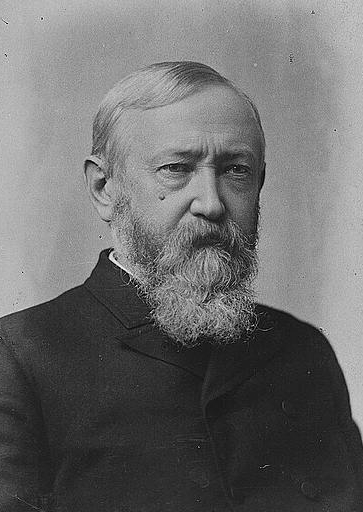
The illustration is taken from the Library of Congress' Prints and Photographs division.