Showing posts with label Democratic Party. Show all posts

Saturday, April 19, 2008

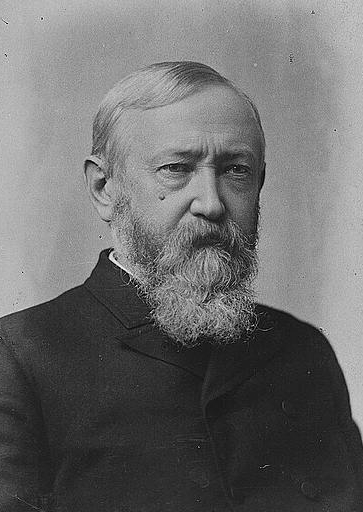
Number 23: Benjamin Harrison

Years in office: 1889-1893
Pre-service occupations: lawyer, Indiana supreme court reporter (elective office), general, U.S. Senator
Key events during his administration: Johnstown, Pa., flood (1889); first Pan-American Conference (1889); Sherman Anti-trust Act (1890); Sherman Silver Act (1890), Wounded Knee (1890), McKinley Tariff (1890); overthrow of Hawaiian monarchy and treaty to annex Hawaii (1892); death of first lady Caroline Harrison (1892); states admitted to the Union: North Dakota, South Dakota, Montana and Washington (all 1889), and Idaho and Wyoming (both 1890).

Presidential rating: Mildly successful and mixed on popularity

ESSAY

Here’s a difficult presidential quiz that you can try on your friends and family. The first question should narrow it down a little:

1) Who was the original trust buster?

2) Who struggled to get civil rights legislation passed?

3) Who was the true author of big government?

4) Who believed that the government had a responsibility to act for the public good?

This was a trick question, of course, and if you said Theodore Roosevelt or Abraham Lincoln to any of the answers, you’re wrong. There’s only one right answer: Benjamin Harrison (naturally, because you’re reading a review about him!).

Benjamin Harrison is probably the most “forgotten” of all the forgotten presidents. Sandwiched between Grover Cleveland’s two terms, sometimes confused with his more famous grandfather, and not celebrated in any way by the Republican Party, Benjamin Harrison seems like one of those people you are duty-bound to write or talk about just because he was president.

However, Benjamin Harrison was actually a decent president, one worthy of being remembered. The first half of his term was unusually successful—but that success helped doom him to defeat. He was not a towering figure in American politics, but he was an important player. Harrison was a strong Christian man who believed that a man should pay his dues—he never traded off his famous grandfather’s name, although the temptation was certainly there. He displayed excellent speaking skills, and used his oratory to secure a place in Republican ranks and set himself up as a thorn in the side of Democrats, whom he considered traitors.

Yet Benjamin Harrison had a reputation of something of a cold fish. Never a party favorite and always seemingly at odds with his secretary of state, the popular and ambitious James G. Blaine, Harrison did his presidential duty and then faded from history. What he helped set in motion, however, would reverberate over the next quarter century, making Benjamin Harrison a key, if not great, president.

Young Harrison
Benjamin Harrison was born in the shadow of greatness. His great-grandfather, Benjamin Harrison V, signed the Declaration of Independence and was a leader of Virginia during the rebellion against the Crown. His grandfather, William Henry, was of course the victor of Tippecanoe, hero of the War of 1812 and the 10th president of the United States. Young Benjamin, however, never acted as if he were royalty or anything special because of his lineage. Instead, he became infused with strong Christian beliefs that were to guide him his whole life.

For example, he grew up believing that a man needed to earn his keep and pay his dues. He never played off the name or fame of his grandfather—or even his own. Even after his term as president, he kept up his law practice. He also served as an elder in his church throughout much of his adult life. He believed wholeheartedly in living a godly life; the Lord was not far from his thoughts—or his actions. His public and private life were one and the same.

However, “stiff” would barely begin to describe Benjamin Harrison. One of the many nicknames given to him was “little iceberg,” and as you can imagine, it wasn’t flattering. Socially awkward and reserved, he nevertheless won the hand of Caroline Lavina Scott, whom he married in 1853.

Harrison struggled to begin a law practice in Indianapolis, where he won his first elective office. When war came, he joined the Union army as an officer and went into action in 1862.

The War
His service in the army mellowed him and made him less stiff. He raised the 70th Indiana Volunteers and saw some minor action in Tennessee and Kentucky before leading it and three other regiments in the Atlanta campaign. Harrison missed the March to the Sea, however, as he was called home to help ensure Republican victories in the fall elections. He later participated in the Nashville campaign and finished the war a brigadier of volunteers. But because of his time with Sherman in the campaign for Atlanta, he actually fought far more battles than Old Tippecanoe Harrison, his grandfather.

It’s also interesting to note that in 1864, Rutherford Hayes refused to leave the Army to campaign for the congressional seat he was nominated for (he won) claiming that anyone who did so “ought to be scalped.” Benjamin Harrison had a completely opposite understanding, believing that ensuring Republican electoral success was just as important as battlefield duty.

Rise of a faithful Republican
There is little to wonder at why Benjamin Harrison became a staunch Republican. Indiana was one of the birthplaces of the Republican party, and many of his grandfather’s beliefs seem to have found root with him as well, concerning duty and country.

He considered the Democrats either traitors or half-hearted supporters of the war, and oppressors of the free blacks. He believed that Republicanism was the true friend of blacks and labor. Why? Republicans had resumed specie payment, pushed a homestead act and, of course, freed the slaves and pressed for civil rights. His pre-presidential speeches rarely failed to emphasize the fact that Democrats were on the wrong (losing) side of the war.

His political career included serving as the Indiana supreme court’s reporter (an elective office), for which he proved diligent, and a failed campaign for nomination for governor. Indiana party leader Oliver Morton thought Harrison an arrogant aristocrat, but when the party’s nominee had to drop out, Harrison made a go and came within 1% of winning the governor’s seat. Later, when Senator Morton died, Harrison took his Senate seat. It was there that the Republicans found him when the time came to select a candidate for 1888.

1888: A suspect election
Benjamin Harrison became president at a time when stump speaking was still an art form. He was an excellent orator and certainly one of the best in the nation. He was frequently sought as a stump speaker, and spoke often around Indiana and the country for such Republicans as Hayes and Garfield, and later, himself.

Why was Harrison tapped for president? It wasn’t because of his grandfather, whose name Harrison never traded off of. Biographer Calhoun writes:

“It is impossible to know precisely when Benjamin Harrison began seriously to consider the notion that he could follow in his grandfather’s footsteps to the White House. After he had won the prize, he told a friend that ‘the thought had been with him many times when suggested by others, but he had never been possessed by it or had his life shaped by it.” (p.45)
It may have even been simple ambition. Regardless, by 1888, Republicans believed they could win the White House again from Grover Cleveland. The party had few prominent and nationally known fresh faces at this time, other than John Sherman and James G. Blaine, who still commanded attention and loyalty. Surprisingly, Blaine, a man would could rightfully be labeled the dean of the Republican Party, declined to run in 1888, leaving Sherman as the only heavy-hitter.

The Hoosier native saw his chance when Blaine decided not to run again. Harrison and his allies built upon his superb oratory skills and stance on the tariff—President Cleveland had made his entire 1887 address to Congress about lowering the tariff—voting rights in the South, and so on.

After numerous ballots at the convention, and with Blaine’s full backing, Harrison won the nomination. The tariff issue dominated the campaign, which featured Harrison conducting America’s first “front-porch campaign” wherein the candidate himself made numerous speeches on his own behalf at his Indiana home.

At this time, Calhoun writes, the two parties had achieved parity: both were pretty equal in terms of strength, and each had its strongholds, but it’s incorrect, he writes, to label this a Republican era because all but one presidents were Republicans. Congress changed hands several times, and the presidential votes were quite close, few more so than 1888.

For the third time in American history—and the second time in about a decade—the victor of the electoral college was not the man with the most popular votes. Harrison won the electoral college 233 to 168 while falling short by 100,000 popular votes to Cleveland. All well and good constitutionally—yet something wasn’t quite right. In fact, something really stank. Harrison attributed his victory to Providence, but a fraudulent voting technique called “block voting” in New York and Indiana, as well as numerous “favor” pledges made on behalf of Harrison—without his knowledge, it seems—sealed an election victory that might not have—or maybe should not have—happened.

Was Harrison elected by fraud? It’s not totally clear. Regardless, Cleveland did not challenge the election and neither did the Democrats. Harrison, unruffled by charges of fraud—after all, he was innocent, right?—went about preparing to do his duty. Four years later, though, the Clevelands would return.

The new president
While reading Charles Calhoun’s meaty biography of Benjamin Harrison, the 23rd president rose in my estimation out of obscurity into the ranks of decent presidents. This is partially because he had such a cussedly hard job to do as president. Once in office, Harrison, like every previous man to hold that position, was flooded with office-seekers—and also “requests” from state bosses and other powerful party men for positions either for themselves or favored sons as payment for services rendered during the campaign. It was a seedy side of politics, one which Grant made a valiant but doomed attempt to reform, and which Hayes, Garfield and then Arthur made some headway in fixing.

But running for president and actually being president are two different things. If you are a man of high character, as Harrison was, you don’t look on being president as (to use the modern term) being a big sugar daddy. Harrison did replace Democrat officials with Republican ones—as was expected, all crying aside—but he balked when it came to his cabinet. James Blaine, the very powerful Maine senator and de facto leader of the Republican Party, wanted the secretary of state’s office. But Harrison, wary of having the polished and refined dandy Blaine as a co-equal in the administration, waited for two months before offering Blaine the position at State. By doing so, Harrison was letting there be no mistake as to who was president and who was merely a cabinet member. Blaine got the message, but their friendship slowly eroded over the next four years.

So did Harrison’s support, because in trying to do the right thing amid the myriad of appointments, he unfortunately angered state bosses, who were not inclined to support him in 1892. They chose politics over the best for the nation, while Harrison, with Christ as his guiding light, chose the best for the nation over politics. And it cost him dearly.

The activist president and Congress
I laugh when modern-day libertarians and conservatives claim that Abraham Lincoln is the author of big government. Most of Lincoln’s measures were either wartime proscriptions that disappeared after the war or were Republican party platform measures that would have been enacted regardless of the war, such as the Homestead Act. Up until the final decades of the century, however, Americans largely looked askance at any intrusiveness of the central government. State control still reigned supreme (the Civil War aside) but more people began to realize that government needed to be larger by default and demanded that government take more action in more areas of people’s everyday lives.

For example, a dam burst caused much devastation and loss of life at Johnstown, Penn., in 1889. President Harrison appropriated federal funds for the town to rebuild (something his predecessor/successor Cleveland opposed) and the president received what could almost be termed a hero’s reception when he visited.

Mainly, though, the activism centered on business and economic concerns, what with labor and farmers demanding more control over their financial well-being, and freedom from the control of Eastern bankers and financiers. The social activism of black rights had faded from the forefront as a national issue after Reconstruction, Indian rights seemed to be fading as the frontier closed in, and women’s rights hovered in the background.

The Republican Party had drifted away from the “waving of the bloody shirt” associated with reforming the South and became tied more to business interests. It’s grossly incorrect to label the Republicans the party of big business during this era, especially because of how presidents from Grant through Harrison acted—and especially the 51st Congress of 1888-1890. The 51st congress, controlled by the Republicans and driven by the idealism of Harrison, was the most activist congress the Republic had ever seen. More than 500 pieces of legislation were passed into law. Biographer Calhoun writes that the activity was a shock on a nation used to a more placid government. And that very activism is what led to the Republicans getting creamed in the elections of 1890, losing control of the House by a huge margin.

That defeat was in the future, and Harrison enjoyed several legislative victories in his first two years, including the Sherman Anti-Trust Act, the Sherman Silver Purchase Act and the McKinley Tariff.

The first was the famous “trust-busting” bill (basically an anti-monopoly bill) that became associated with Teddy Roosevelt instead of Harrison, even though 12 suits were brought during the next two years under Harrison. The second was a sticky situation that was less of a victory and more of a troublesome compromise. It increased the amount of silver that the government bought each month—but the bill was far short of the free coinage of silver that Western silver backers wanted—silver being found in abundance in the West. Essentially what this meant was that government money was backed by both silver and gold, with gold in greater proportion to silver. But people turned their silver notes in for Treasury gold, which depleted government gold and led to the Panic of 1893. (See the previous entry on Grover Cleveland for much more on this debate and the Panic.)

The third was a big victory for Harrison—and for the next Republican president, Congressman McKinley—in that he had campaigned on protectionism. The tariff bill was passed in part because Republicans lent support to the silver act, and also in part a response to a very high Treasury surplus, which the new tariff legislation would eat away. The Republicans pledged to protect American manufacturers from “unfair” foreign competition, and a lower tariff was intended do much to protect business while easing the burden on the Treasury.

However, the silver and tariff bills wound up not helping the Republicans in the fall elections—particularly, I think, because Harrison’s longed-for civil rights bill was postponed—and the GOP lost seats. The civil rights bill, which never came to pass because of GOP seat loss, would have used federal authority to help secure black citizens the right to vote in the south. Harrison strongly believed that blacks had—and were even owed—a place at the political table, and he sought to secure their freedoms from the Southern governments, all controlled by Democrats. But his efforts unfortunately bore no fruit, and the failure to get a civil rights bill was a bitter disappointment.

The 1890 elections
As mentioned, the Republicans lost heavily in the fall elections, and control of the House transferred to the Democrats. The aforementioned activism greatly aided in Republican defeats.

Another, equally important reason why the Republicans lost was the president himself. Harrison’s negative reaction to the demands of appointments sullied his name among party leaders. Despite the reforms battle that had come to a head during Chester Arthur’s term, appointments remained the biggest way you “played to your base,” but Harrison was more interested in doing what was right for the country than what was right for the party. Consequently, both he and the party suffered for it. There was simply less enthusiasm and energy for the party in 1890 than there was in 1888. (Sounds familiar, doesn’t it.)

The 51st Congress’ session didn’t end until March 1891; so, there was more work to be done. But Harrison would not get his long-sought civil rights bill, however, due to a combination of financial crises (which Harrison and his Treasury secretary handled as well as the Federal Reserve would in the 20th century) and further agitation from the silver coin crowd.

When the 52nd congress came in, Harrison’s cherished civil rights bill died forever. Even Harrison’s attempts to try for compromise failed. Racist white supremacist Democrats and uncaring free-silver Western Republicans killed the bill over unfounded fears of a “new Reconstruction.” The aged Frederick Douglass, however, noticed and called Harrison a great president and friend of blacks (similar to comments he gave about Grant).

Blaine troubles
The first two years of the Harrison presidency seemed to be happier than the final two, with good reason (more on that later). But it seems that the Blaines, and another stalwart of Republican politics, Rockefeller, snobbishly looked down on the simple and pious Harrison and his wife, Caroline. Blaine also worked at cross purposes with his boss, even writing public letters against proposed or official policy and then privately writing his boss that he hoped he hadn’t said anything to upset Harrison.

I have developed a dislike of Blaine—the kind of politician I could really do without. He seems like a political snake—or at least a Machiavellian. I didn’t like him much on a personal level when I was reading the biographies on Cleveland, and I certainly don’t like him now. An important figure, certainly, and very competent, but a politician through and through.

International actions
Internationally, Blaine and Harrison worked together with England and Germany in what was America’s first foreign treaty of cooperation. America and the two European powers came to an agreement concerning portage rights in Samoa.

Harrison also presided (nominally) over the first Pan-American congress, which was the loving brainchild of his secretary of state. Blaine had originally conceived the idea of a conference of American nations to come together for peace and stability during his short term as Garfield’s secretary of state in 1881. He kept the idea going during the terms of Arthur and Cleveland—neither was interested—and he finally got the chance to revive the idea almost a decade later. This First International Conference of American States was held Jan. 20-27, 1890, but to his disappointment, it wasn’t what he expected it would be. The conference focused more on commerce and industry and less on avoiding war through mutual commerce and cooperation.

Even though the conference fell short of expectations, it nevertheless proved to be the starting point for the Pan American Union (PAU), which still exists today.

In Hawaii, a cabal of American businessmen, Europeans and Hawaiians who called themselves the Committee of Safety overthrew Queen Liliuokalani and established a new government. A treaty of annexation was sent to President Harrison, who, uneasy at first, sent it to the Senate. President Cleveland killed the treaty during his second term after learning more about what actually happened. (See the Cleveland entry for the full story.)

Massacre at Wounded Knee
In 1890, the last action of the Indian Wars took place, the battle or massacre at Wounded Knee, S.D. Harrison was continuing the policy that Grant first put in place to press for citizenship of Indians but punish those who committed crimes.

The real culprit in this sad episode seems to have been a corrupt Indian agent who made unfulfilled promises and also made great exaggerations regarding the “hostile” nature of the Sioux’s Ghost Dance. Harrison had been ordering caution and was reading Gen. Nelson Miles’ report on the situation when word reached him of the battle/massacre. Mainly, it seems like the it was a situation that just got out of hand, and the Sioux were more victim here than aggressor. The colonel in charge was brought to a court martial but was exonerated. The sad affair did not prompt any change in policy by Harrison. Calhoun writes that the president viewed it more as an unfortunate incident than the watershed event we now look on it as being.

End of the administration and loss to Cleveland
Harrison and his team successfully averted a cholera outbreak by halting immigration, but he received little praise for it. Instead, he lost support among immigrants over labor and immigration issues. Some I agree with, others I do not, like the continued banning of Chinese immigrants, begun by Cleveland. Harrison—unfairly—took hits over labor unrest.

Worse, Harrison’s actions in 1889 and ‘90 were now hurting. There was a movement to make the ailing Blaine the nominee, and state bosses and bigwigs were not too thrilled with Harrison over appointments. Blaine and Harrison fell out—Mrs. Blaine was open with her contempt, even hatred of Mr. and Mrs. Harrison—so that when the “draft Blaine” movement gained strength, Blaine finally resigned from State. Curiously, Harrison did not pull out all of the stops on securing the nomination until two weeks before the convention. When he finally did, he only got 60% support. The remaining 40% of the delegates split their support between Blaine and McKinley.

Cleveland, on the other hand, easily secured the nomination. Democrats were ready this time around, and made alliances with the Populists and even free-silver Republicans. There wasn’t much enthusiasm on the Republican side, and Cleveland won.

But probably the biggest factor (which Calhoun doesn’t go into that much) was that the standard bearer himself was absent. Caroline Harrison had been sick throughout much of 1892 and had finally been diagnosed with tuberculosis. Harrison avoided all campaigning, preferring to remain with his dying wife. She succumbed in late October, two weeks before the election. How in the world could a man campaign under such a circumstance? He couldn’t, and he didn’t. (Cleveland halted his campaigning out of respect.)

Still, Harrison left office believing (correctly, I might add) that he had done the best possible job he could, and that his administration had served the public interests well. He did leave with a black eye, though, over the shameful coup in Hawaii. It is highly unlikely that Harrison had anything to do with it, but he nevertheless approved that it had happened and sent annexation papers to Congress. Nothing happened on it, though.

After leaving the White House, Harrison returned to Indianapolis, where he resumed his law career.

He then married a widow, Mary Scott Lord Dimmick, in 1896. She wasn’t just any widow, but Caroline’s niece and his longtime pen-pal confidant. Many in his family didn’t approve of the marriage.

In 1899, he attended the First Peace Conference at The Hague. He died in 1901.

Final assessment

Benjamin Harrison was a president who served with honor. He’s “forgotten,” but he and the 51st Congress set some things in motion that, in a way, we’re still dealing with. A tremendously activist central government came out of his presidency. It was still a far cry from the almost wholesale reordering of the relationship between government and governed during the FDR years, but nevertheless, American government began to change in a fundamental way during the Harrison years that’s only now beginning to be understood.

I don’t want to oversell Benjamin Harrison or this change, however. To get an idea of the change, imagine if you were expecting an inch of snow and you get four inches instead (as opposed to expecting a dusting and getting a blizzard).

Writes Calhoun:

“Benjamin Harrison had not set out to transform the presidency, but he was hardly a mere caretaker between the two terms of Grover Cleveland. In his own right, Harrison made important contributions to the office. He entered the presidency strongly committed to a set of principles and policies. In defense of those ideas and in pursuit of what he thought to be his duty, he expanded the boundaries of presidential activism. Both publicly and behind the scenes, he effectively intervened in the deliberations of Congress and posted a remarkable record of legislative achievement. He resisted the dictation of party bosses in the matter of appointments, thereby risking his own reelection for the sake of presidential independence. He frequently operated as the nation’s chief diplomat and shaped its aspirations in foreign affairs. Through skillful use of the press and in widespread travels, he took the presidency to the American people.” (p.165-166)

Indeed. Fellow Republican McKinley learned many lessons from the 23rd president, and used them to good effect as the 25th president.

Resources

Charles Calhoun’s study on Benjamin Harrison for Schlesinger’s American Presidents series proved most illuminating. The casual reader could easily get lost in discussions of policy, especially the nebulous realm of tariffs. And it may seem that knowing President Harrison is perfunctory merely because he was a president. However, that attitude does him a disservice.

The Presidency of Benjamin Harrison by Homer E. Socolofsky and Allan Spetter, 1987, from the University of Kansas’ The American Presidency series is also useful for understanding not only Harrison’s term, but also the near 50-50 politics of the Cleveland/Harrison era.

The illustration is taken from the Library of Congress' Prints and Photographs division.

Sunday, February 3, 2008

Numbers 22 and 24: Grover Cleveland

Years in office: 1885-1889, 1893-1897
Pre-service occupations: attorney, sheriff, mayor and governor
Key events during his administrations: 1st term: veto of pension bills, Geronimo campaign (1885-86), Haymarket Riot (1886), Interstate Commerce Act (1887), Dawes Act (1887); 2nd term: Chicago Exposition (1893), Panic of 1893, Pullman strike (1894), rejection of Hawaii annexation and subsequent recognition of the Republic of Hawaii (1893-1894), repeal of Sherman Silver Purchase bill (1893), J.P. Morgan gold purchase syndicate (1895), Olney Interpretation (1895), Utah admitted to the Union (1896)

Presidential rating: First term: Mildly successful and mixed on popularity. Second term: mildly unsuccessful and unpopular

ESSAY

He’s been called unfailingly honest. A dull speaker. The “Buffalo Hangman.” A man above party.

Grover Cleveland was all that and more. The 22nd and 24th president was unique in more ways than one. First, and most obvious, he was the only non-consecutive two-term president. Second, was the only Democrat elected president between 1860 and 1912. Third, he was the only president during the last half of the 19th century to not serve in the Civil War. And fourth, before Franklin Delano Roosevelt, he was the reigning champion for winning the popular vote in presidential elections, in 1884, 1888—when he lost the electoral vote—and 1892.

Of course, there’s far more to the man, and there’s a lot I like about him. Cleveland has undergone something of a reassessment of late, and one thing floats to the top that many historians like: his unfailing honesty. That honesty, which his contemporaries acknowledged and admired, elevates Cleveland to the upper tier of presidents.

Understanding Grover Cleveland is not easy. For decades, writes biographer Richard E. Welch, historians though they had him pegged as the paragon of political honesty amid a sea of Gilded Age corruption and a political wasteland. Later reassessments removed Cleveland closer to the bottom of the heap, as he was labeled a “Bourbon” Democrat who deserved scorn for failing to live up to those historians’ new theories on the social and political movements of the era. For example, Cleveland was no supporter of suffrage (women’s voting rights), but few other people were, either. Cleveland needs assessing by the terms of his own era.

Nowadays, Cleveland is enjoying a reassessment that more or less places him back where he started: an honest, often contradictory and practical man who took things as they came.

President Cleveland foreshadowed the coming progressive movement in words, if not in actual deeds. He was tightly frugal with the public’s money and believed in, to use the modern cliché, a level playing field. Companies and barons that horded most of their profits without elevating those who brought them the profits earned his particular scorn. But likewise, he refused to place people under the government’s charge, believing that the people supported the government, not the other way around.

He was the last president to take a largely hands-off approach to most aspects of national and public life, fully embracing the original concept that the president was the nation’s chief executive, meaning he was the executor of the nation’s laws and policies. His administrations bracketed the first truly activist presidency (Benjamin Harrison’s) and was, in some ways, a fitting coda to the 19th century. A man of deep principle and privacy would soon be forced to give way to nation demanding much more from government, much more from media and much more from the president himself. Yet at the same time, Cleveland continued the expansion of executive power in subtle ways.

Cleveland, it can be said, was the last of the old guard while simultaneously being the first of the new guard.

The rise of a “Bourbon” Democrat
Stephen Grover Cleveland, born in 1837, stopped in Buffalo when he was 17 looking for work. His father had died recently and he needed to help support the family. His uncle, Lewis Allen, was influential in Buffalo and introduced him to a career in law. The young Cleveland took a clerkship, read law and was admitted to the bar in 1859. (The firm Cleveland joined was Rogers, Bowen, and Rogers. Previously it was known as Fillmore, Hall and Haven, and is known today as Hodgson Russ LLP, the only firm in the country that can boast of having had two presidents as partners, the other being Millard Fillmore, of course.)

Meanwhile, Cleveland entered the politics of the Democracy (as some referred to the Democratic Party back then) in his native New York when he was 19. He campaigned for James Buchanan and ran for his for office in 1865—and lost. His uncle was a staunch Whig, but Cleveland believed firmly in the ideals of the Democratic Party, especially his ideological heroes, Jefferson and Jackson. He would eventually become associated with the “Bourbon” Democrats (See: Explaining the Cleveland approach to government), especially after his terms as president.

He remained at his law practice during the war until January 1863, when he accepted the post of assistant district attorney for Erie County. When Cleveland received a draft notice in 1863, he hired a replacement to fight in his stead. In 2008, such a move would have been political suicide, but Cleveland would suffer politically only partially for not wearing the uniform, and then only after he became president the first time. His strength of character and a combination of events—and different times—was more than enough to override such concerns.

Cleveland was a playful young man who liked the outdoors. He frequented pubs and taverns, relishing good food and good beer. The pubs and taverns, though, were not just places to satisfy his thirst and hunger: before the age of mass communication, they served as the meeting places for political meetings. Young Cleveland whet his chops on more than just beer and mutton at these places: he’d stand on a crate or barrel and speak his political mind to would whoever listen. And listen they did. He wasn’t a great stump speaker, but—to use the word most often applied to him—Cleveland was an honest one.

His single-minded devotion to whatever tasks were set before him led Cleveland to be elected to his first office in 1871: sheriff of Erie County, which includes Buffalo.

A fast track from hanging judge to presidential nominee
Many people today look for “experience” on the resume of presidential contenders. On paper, Grover Cleveland had an impressive resume: A lawyer, sheriff, mayor of Buffalo and governor of New York. Sounds good. However, the future president wasn’t in the elective positions for a relatively long period of time—at least by the modern understanding of “experience.”

He served as sheriff, mayor and governor for one term each. But in each of those terms, Cleveland earned—truly: earned—a reputation for honesty and strength of character and devotion to duty that was astounding. During his term as sheriff, Cleveland executed two condemned criminals himself. Later, political enemies tried to sneer at the “Buffalo Hangman,” but Cleveland, nonplussed, explained he wouldn’t have anyone do something he couldn’t do himself.

In 1882, Buffalo elected him mayor. “Public office is a public trust” was his campaign slogan, and he proved true to his word. His reputation for honesty and trustworthiness with the public’s money and public responsibility took root during his mayoral service, through such actions as refusing to award contracts to the highest bidder, instead of the lowest bidder. He took on the local machine politicos and won.

The next year, his fame as Buffalo’s mayor elevated him to the governor’s mansion. He defeated an ally of President Arthur for the office—exposing major weaknesses in the Republican Party’s New York machine—and proceeded to operate the same way as governor as he had as Buffalo mayor.

Governor Cleveland had embraced the reform sweeping the nation, but not wildly so. His approach was practical: reform, but with limits that would not totally destroy the political structure. Biographer Henry F. Graff explains:

“In addition to being morally offended by the excesses of the spoils system, Cleveland understood the change in the requirement of government in the 1880s. The political tradition that “to the victor belongs the spoils” was plainly out of date and had to be abandoned. Still, Cleveland was not unmindful of the need to nourish the political parties, but in his appointments he balanced as honorably as he could the demand for both party loyalty and professional competence. For example, he appointed the assistant in the insurance department to be its director. In filling the ranks of the Railroad Commission, Cleveland chose so carefully that it became a judgment on his stewardship that as well as a feather in his political cap that New York State had less organized hostility to the behavior of the railroads than any other state in the Union.” (p.36)
Balancing the needs of party and competence was but one of many good marks he carried into the presidency.

It is noteworthy that a Cleveland ally in the New York legislature was a young Republican named Theodore Roosevelt, who approved of Cleveland’s conservation efforts at Niagara Falls and words against corporations.

Cleveland’s term as governor was cheered throughout the state—except the anti-reformers of the old Boss Tweed’s Tammany Hall, taken down by one of Cleveland’s predecessors, Samuel Tilden, and, of course, by many of the Republicans. But not all: Some Republicans grudgingly admitted that Cleveland kept his promises and did what he said he would do.

National party leaders took note of this newest New York governor as a strong contender for the 1884 election.

The election of 1884; or, how to handle a scandal
Republicans and Democrats put fourth platforms in 1884 that were remarkably similar: they both favored protective tariffs, they both favored a stronger currency backed by gold, they both favored limits on immigration (especially the Chinese). Both parties even held their conventions in the same hall in Chicago, two weeks apart. The election, therefore, turned on personality—and ugly campaigning.

Republicans were for once without a truly nationally appealing candidate who could unite all factions of the party. President Arthur made only a halfhearted attempt at the nomination. Grant was ailing and would be dead the following year. The promising meteor Garfield was dead. Roscoe Conkling had greatly overreached and was gone, and his Stalwarts were fading. Famed Union general William T. Sherman told the party to take a hike, famously remarking “If nominated I will not run. If elected, I will not serve.” That left James G. Blaine of Maine, last seen as Garfield’s secretary of state. Blaine wanted the nomination, and after beating back Arthur’s half-hearted attempt, won the nomination.

Although a forceful personality and full of vision, Blaine turned off enough Republicans who defected to the Democrats. These “mugwumps” would not vote for the “corrupt” Blaine, who had been accused of shady railroad funding (that had derailed his previous run for the presidency in 1880). Although Blaine was a strong and talented man, his candidacy bore the flavor of so many men who run for the presidency on their party’s ticket because it is “my turn.”

Cleveland won his nomination after his supporters beat back an anti-Cleveland attempt, but the outcome was not seriously in doubt. However, his was a fresh face—literally in one way, because Cleveland did not have a beard. (Of the presidents from 1860 on, Grant, Hayes, Garfield and Arthur and Harrison sported full whiskers; Johnson and McKinley were clean-shaven. Lincoln had only a beard while Cleveland had only a mustache. William Howard Taft would be the last president to have any kind of facial hair.)

The campaigning is where things got interesting—more specifically, when supporters and sympathetic press began making speeches, marches and running editorials. This was still the era when candidates usually didn’t themselves campaign, but Blaine was an exception. He made hundreds of speeches that summer and fall. Cleveland ran his campaign from his home in Albany. Cleveland wasn’t even at the convention.

Shortly after the Democratic convention in early July, a Buffalo scandal sheet ran a story claiming Cleveland had fathered a child out of wedlock, the child had been sent to an orphanage and the mother was in an asylum. When a respectable paper ran with the story, Republican press and supporters immediately pounced on the story as proof that “honest” Cleveland had no morals and was unfit for the presidency. Republican rallies were soon filled with baby carriages and the chant, “Ma, ma, where’s my pa? Gone to the White House, ha, ha, ha!”

Rather than deny the charges, Cleveland said simply, “Tell the truth,” which has become the gold standard for dealing with scandal. The “truth” was very close to what the rag had printed. Cleveland had had an “intimate” relationship with Maria Halpin, but it was not known who the father was. Apparently, his married law partner, Folsom, may have also had relations with the woman. When she turned up with a child, Cleveland assumed financial responsibility both to do the right thing and to prevent any possible embarrassment for his partner. When Halpin developed a serious drinking problem, however, Cleveland had her committed and the child sent to an orphanage—whose expenses he continued to pay.

Cleveland made a smart move, because by owning up to what was going on, he negated a lot of the charges’ impact. He was, however, completely humiliated and angered by the intrusion into private affairs, and also angered at his treatment by certain people in Buffalo. He rarely returned to the city after that.

The campaign remained close until the end, when Blaine failed to counter a New York preacher speaking on his behalf against the Mugwumps as not real Republicans for joining the party of “rum, Romanism and rebellion” (e.g., the Democrats). The perceived slur against Irish and Catholics made it seem as if the Republicans were once more waving the bloody shirt, biographer Graff writes, and it made sure New York went for Cleveland. At that time, if you won New York, you won the presidency, too. Graff says it’s not known how many votes switched because of the fabulous flub, but it was enough.

Cleveland won 219 to 182 electoral votes and by a mere 20,000 popular votes.

Gleeful Democratic editors now had an answer to “Ma, ma, where’s my pa”: “Hurrah for Maria! Hurrah for the kid. I voted for Cleveland, and I’m damned glad I did.”

Explaining the Cleveland approach to government
Cleveland would eventually be known as a “Bourbon” Democrat—in fact, the term is closely identified with him more than anyone else. The oddly named Bourbons supported business interests, opposed the protectionism manifested in the high tariffs, supported railroads, opposed imperialism, supported sound money (gold standard) and opposed bimetallism (free silver). But as we’ll see, the term Bourbon Democrat doesn’t quite fit with Grover Cleveland.

As alluded to earlier, Grover Cleveland believed that the president’s primary duty was to execute the legislative branch’s laws, but he also believed that the chief executive, being the only official elected by all the people, needed to curb the excesses of the Congress. He freely used the veto to slap down—often unsuccessfully—bills that went against what he believed constituted the government’s true functions.

No deep thinker or theorist, Cleveland instead was a pragmatist who approached issues one at a time. He sometimes contradicted himself, a tendency which added to his reputation of being “above party.” Toward the end of his second term, this caused great distress in his party, because he believed he was right and those with different views were at best wrong and at worst party heretics. He talked a great game about fighting corporations and monopolies in favor of the common man, but critics charged that he was a faithful ally of those same business magnates. The appearance was deceiving, because while the president was not an adherent to laissez faire (despite the label of Bourbon Democracy), he was a firm believer that the federal government should not have any favorites. In fact, during a veto message in 1896, biographer Welch explains that Cleveland wrote that the federal government’s purpose was “the enforcement of exact justice and equality” and not to spread favors to one group or another. (p.14) Welch further explains:


“A consistent theme throughout both administrations…was his conviction that governmental paternalism could only encourage a dangerous dependence on the federal government, destroy the American tradition of local charity and self-help, and undermine the independence and therefore the virtue of the citizenry. Governmental paternalism could, indeed, erode the very foundations of popular government if ever the electorate could see the government not as an instrument of their creation demanding their loyalty but as a source of gifts and privileges. Paternalistic government could only change the relation of the citizen to the government: instead of being a sovereign, the citizen would become a dependent.” (p.13-14)
Cleveland’s ideological heroes, Thomas Jefferson and Andrew Jackson, would probably agree. Cleveland, however, often seemed to draw on Jefferson’s polity principles when needed and Jackson’s strong-armed executive when needed. For example, the president certainly changed his mind between his first and second administrations. During the first term, Cleveland adhered to the 1884 Democratic platform, which called for less centralization and more state sovereignty. Yet during the second, he willfully used federal soldiers to break the Pullman strike over the strong objections of the Illinois governor—asserting executive authority to perverse law and order. Welch explains:


“Like his hero Andrew Jackson, Cleveland could simultaneously speak against the centralization of power in the federal government and expand the power of the federal executive. Cleveland’s interpretation of the traditions of the Democratic Party was, at the least, flexible. He quoted Jefferson when denouncing federal interference in local elections, but acted like Jackson when he overrode Governor Altgeld and claimed supremacy for the federal government and its chief executive during the Chicago railroad strike.” (p. 147)
In simpler terms, Cleveland took a little from column A and a little from column B and produced what could be termed Cleveland Democracy.

It would certainly be odd to find Grover Cleveland celebrated in today’s modern, liberalized Democratic Party, considering he opposed the very mentality the party now stands for. In fact, Welch relates how in 1979 JFK intimate Arthur Schlesinger, Jr. argued that “conservative” President Jimmy Carter should be dumped in favor of liberal Ted Kennedy, using Cleveland as a Carter archetype!

Modern conservatism, though, should find much to admire in some of Cleveland’s anti-paternalism beliefs.

The first term begins
With the Democrats back in the White House for the first time since 1857 (the Andrew Johnson aberration notwithstanding), the Democrats were naturally eager to take their share of what for so long had been denied: federal appointments. The fitful civil service reforms of the previous administrations had changed only so much, and Democrats wanted—demanded—offices.

Cleveland wanted to put the best men possible in all available posts. The trouble was, Graff explains, the quarter-century Republican run on the presidency conversely produced a dearth of Democratic talent in high government places. Cleveland wound up recruiting cabinet and other officials from business and railroad interests (while inadvertently snubbing some old friends) and from the party. Two were former Confederates, appointed in part to be a symbolic gesture of a healed nation.

The result was a respectable, if not outstanding, cabinet. However, it contained no representatives from laborers, farmers and others on the lower end of the political, social and economic spectrum. While that may seem like a modern-day, squishy multi-cultural lament, it proved to be an oversight, because President Cleveland would prove to have something of a tin ear when it came to matters that concerned the agrarian Midwest, South and West.

President Cleveland soon ran afoul of the self-anointed reformers, who demanded a justification for every dismissed officeholder. The “justification” was simple enough: they were Republicans and Cleveland was a Democrat, and now the Democrats were in office and Cleveland was doing what had been done since the age of Jackson. The President ignored the reformers’ demands, though, and he actually made fewer office changes than his predecessors (who were all Republicans).

Cleveland’s vice president would not last the term: Thomas Hendricks, who had been Samuel L. Tilden’s running mate, died in November 1885.

The vetoes and the railroads
President Cleveland began exercising his right to veto legislation almost at once. It’s possible that a more eloquent president, or a man who had the advantage of modern mass communications, could have better explained himself, because some of his vetoes would cause him unnecessary woe. For example, he vetoed hundreds of pensions for Union veterans, most of which were put fourth by northern and western congressmen as favors for people in their home districts. Many of the bills were frivolous. Cleveland denounced the pensions as raids on the public treasury. He also vetoed Congress’ bill granting a pension to all Union veterans for disabilities not stemming from the Civil War. Southerners didn’t care, naturally, but many Northerners were furious at the Democrat Cleveland, a man who hadn’t served, denying the benefits (and with sometimes sarcastically worded veto messages)—even though he was technically right.

The president, however, did not just veto pension bills and relief bills to farmers whose crops were ruined by drought. He struck down any bill he believed contained measures and funding arrangements not authorized by the Constitution—as he believed was his duty. The “little guy,” so to speak, was not the only one to feel the wrath of Cleveland. The president targeted railroads for investigation of fraud for holding onto government land grants that they never used. This land was ripe for settlement and, Cleveland and his Interior minister argued, was rightfully the government’s.

Angry railroad investors complained, albeit fruitlessly. In all, 81,000,000 acres of land grants returned to government control—equivalent to the size of New Jersey, Delaware, Maryland, Virginia, Pennsylvania and New York, if put together in one lump.

But Cleveland was not done with the railroads, and neither was Congress. Finally responding to longstanding complaints from westerners, especially farmers (who were organizing into “Granges”), Congress created and Cleveland signed the Interstate Commerce Act in 1887, which also created the Interstate Commerce Commission, the first true regulatory agency in American history. The ICC’s specific mission was to regulate prices on the railroads and eliminate abuses and discrimination in hauling freight and passengers.

Haymarket
Although a welcome addition on the Plains and in the west, the ICC didn’t exactly endear Cleveland to non-Eastern Democrats. Nor did he help himself much with labor relations during his first term, mainly because of his “no favors” philosophy.

For decades, the laboring, wage-earning class had been growing in numbers and growing restless. By the mid-1880s, there truly seemed to be a clear dividing line between the haves and have-nots. The great strikes of the summer of 1877 during President Hayes’ term were just the beginning. In 1885, the American Federation of Labor formed under the leadership of Samuel Grompers.

In May 1886, tensions in Chicago literally exploded when a bomb was thrown into the midst of police marching to break up a peaceful meeting of strikers, which had just ended. A policeman was killed and they fired on the crowd. More people were killed and many more injured in the subsequent Haymarket riot.

Haymarket would, in a way, provide the rallying cry for the 8-hour work day. Cleveland played no role in the chaos in Chicago—this time. The next time Chicago witnessed chaos and bloodshed and strikes, Cleveland sent in the troops.

Geronimo campaign and the Dawes Act
The second-to last great campaign in the west came during Cleveland’s first term. Chiricahua Apache led by Geronimo (or Goyaale) resisted government attempts to enforce reservation life. Apache lived in the New Mexico and Arizona territories. For a while, Geronimo and his followers acquiesced to the entreaties Gen. George Crook and lived on a reservation for a short while. But they broke out again in 1885. Crook was replaced with Gen. Nelson A. Miles—the same general who had fought the Nez Perce.

President Cleveland authorized a major campaign against Geronimo. In 1886, Miles did just that, using up to one-fourth of the army to capture the Apache and his few dozen followers. A Lt. Charles Gatewood negotiated a peace where the Apache would be transferred to a Florida reservation. (Miles, in one of the most dishonorable actions of the 19th century army, shipped Apache Army scouts off with the Geronimo renegades too.)

The Geronimo campaign mattered little as far as Cleveland’s presidency was concerned, for he would miss the final “battle” on the frontier. His successor/predecessor Harrison would bear that ignominy.

On a different note, Congress passed the Dawes Act in 1887 that authorized President Cleveland (and his successors) to survey and allot tribal lands to individual native families. The overall effect of this short-sighted act was negative, as it wound up costing many tribes and families their lands. It was actually a good deed attempt (possible noble, but I wouldn’t go that far) that just wasn’t thought through.

Foreign policy—first term
President Cleveland’s foreign policies during 1885-1889 were benign and isolationist. He had no intention of involving the United States in the European powers’ game of gobbling up colonies. He backed away from the “entangling alliances” of involvement with England and Nicaragua over a canal and a treaty with Berlin over a trade agreement in the Congo.

The president, though, foresaw the need for a better navy. Building upon what Chester A. Arthur started, Cleveland and Navy secretary William Whitney pressed for continued modernization of the navy. Cleveland had no aggressive designs for the navy; however, his modernization program would greatly assist his second successor’s aggressive use of said navy.

He also sought appropriate coaling stations for ocean-going squadrons, especially in places like Hawaii—a place that would figure prominently in his second term. The navy buildup would more or less continue through McKinley’s terms.

The tariff battle
In keeping with his nature of being against a government of favors, President Cleveland urged Congress to reduce the protectionist high tariffs. In a highly unusual step for a president, he devoted his entire third annual message to Congress (in 1887) to the issue. He directly confronted Republicans and protectionist Democrats in blunt language, warning that disaster was pending and the blame would rest with Congress if it didn’t act.

Cleveland charged that “When we consider that the theory of our institutions guarantees to every citizen the full enjoyment of all the fruits of his industry and enterprise... it is plain that the exaction of more than [the minimal amount of taxes] is indefensible extortion and a culpable betrayal of American fairness and justice.” Therefore, the high tariffs had to go. Besides, he argued, the high tariffs prevented foreign competition, and lower tariff would satisfy business and labor alike by making raw materials and finished products cheaper, thereby opening more markets and making labor happier.

Cleveland was correct in his pointed, if caustic, assessment. Like his immediate predecessor, Arthur, he believed the high tariff was bad news for the economy and the country. Cleveland did not persuade Congress, and a reduction bill failed to pass. The Harrison administration and Rep. William McKinley would tackle the tariffs, but not in a way Cleveland approved. When the Panic of 1893 hit, Cleveland’s warnings seemed to have come true.

A White House wedding—and a meddlesome press
Grover Cleveland, as we have seen, was a workaholic who rarely took breaks. Occasionally he and a companion would go fishing, although on one occasion he made the political mistake of doing it on Decoration Day.

The old cliché of “love at first sight” bears real weight for Grover Cleveland. In a tale too strange for fiction, Cleveland loved his future bride from when he first set eyes on her as a baby. Frances Folsom—his partner’s daughter—was more than two decades his junior, a fact he was painfully conscious of.

But the socially awkward Cleveland came to love Frances—Frank, he called her—as she grew to young womanhood. When his partner died and he took his widow and Frances under his care, his love grew stronger until finally, in 1886, they were married in the first and only wedding ceremony held in the White House.

The Clevelands took a holiday in western Maryland where, to his dismay and disgust, the press easily found them the next morning. The president decried the reporters’ “colossal impertinence” for intruding on his honeymoon, but as Graff writes, was helpless to do anything about it (p. 80). The opulent tastes of Chester A. Arthur had given reporters a thirst for the private lives of presidents that wasn’t easily slaked. And the intrusion into the Clevelands’ happy moment was but the first of countless unwelcome media impositions that in a later age would be justified under the catch-all phrase, “the right to know.”

However, Cleveland wasn’t blameless before reporters. He bore a grudge against the media because of the whole Halpin mess, and he maintained an aloof stance from honest reporter inquires. Consequently, his image suffered. Never a brilliant communicator, Cleveland eventually turned off even friendly media in his second term.

1888 and defeat—for the moment
Grover Cleveland felt confident going in to the 1888 election. But in an odd twist, for the third time in American history the man who won the popular vote was not the same man who got the most votes in the electoral college. (The two prior occasions were in 1824 and 1876, both of which were decided in the House under much different circumstances.)

The Democrats quickly renominated Cleveland at the convention in St. Louis. The Republicans nominated Benjamin Harrison, grandson of the former (and short-lived) president.

By now, politics had become the national pastime. Although the duotone had yet to transform media and pictures were still rendered via gorgeous woodcuts or color lithographs, images of the Clevelands and the Harrisons appeared everywhere on trinkets, souvenir items, broadsides, and so on. Pictures of Frances were particularly favored—no great surprise.

Cleveland and the party ran a “disjointed” campaign, full of “lifeless leadership,” according to Graff. He was also prey to a dirty trick by an ally of the Harrison campaign, where a man posing as “Muchison,” a former English citizen, wrote to the British ambassador in America who he would suggest supporting in the coming election. The ambassador said Cleveland was probably the best as far as England was concerned. The phony “Muchison” published the letter, and it apparently had the same effect on New York as the “rum, Romanism and rebellion” crack had on Blaine’s campaign four years earlier.

Cleveland lost New York and Harrison barely eked out an electoral victory over the president, who nevertheless won more than 90,000 more votes than Harrison. There is some evidence that fraud may have helped Harrison win, too. Cleveland was nonplussed, and bowed to the electoral defeat. Francis Folsom told White House staff that they would return in four years.

The Clevelands retired to New York City, where the ex-president finally relented and lent his name to a law firm. In exchange for the prestige of his name, Cleveland indulged in his favorite pastime: work. Although the happy couple were by no means wealthy, they were comfortable. During this interim period, they began having children, including Ruth, who, according to some accounts, was the inspiration for the Baby Ruth candy bar (others claim that baseball hero Babe Ruth was the source).

Cleveland watched the events of the Harrison era with dismay and also the grim satisfaction that he believed he was right. Harrison, while not exactly an anti-Cleveland, approached government differently, and with a willing Congress, promoted an activist federal government. Harrison approved pensions for all Union veterans, approved “pork-barrel” bills and other things Cleveland abhorred—especially the highest tariff in American history. The McKinley Tariff, passed in 1890 with President Harrison’s support, helped the Democrats in the fall elections. That, and Harrison’s dealings with his party and fractured relationship with his secretary of state, James G. Blaine, made Democratic prospects seem rosier in 1892.

Biographer Graff writes (p.100) that it’s not entirely known whether Cleveland decided to throw his hat in the ring in 1892 out of a desire for political vindication, a need to finish his work as president or sheer boredom. Regardless, he began making speeches again in 1891 to various clubs and organizations on economic issues, and emerged as the party favorite to win back the presidency.

1892
Ex-president Cleveland made history in 1892 by becoming the first—and so far, the only—former president to run and win a non-consecutive term to the White House. (Note: only Jimmy Carter and George H. W. Bush could do so as of this publishing. Bill Clinton and G. W. Bush are prevented from serving again by the 22nd amendment.)

Cleveland won his nomination rather handily, while President Harrison, though seeming damaged goods, easily won re-nomination despite a challenge from Blaine. The campaign that year centered on the tariff as well as hard money versus silver. In another close election, Cleveland defeated Harrison 46% to 43% of the popular vote and 227 to 145 electoral votes (a Populist party candidate took 8% and 22 electoral votes).

I’ll say much more about this election in my write-up on President Harrison, because the reasons for the election’s outcome have more to do with Harrison’s defeat than Cleveland’s victory.

Regardless, Fannie’s words to the White House staff four years earlier had come true: The Clevelands were back.

The second term—not the same as the first
President Cleveland’s second term had a much different flavor than the first. He was still the same man—men of his character don’t change—but the country had shifted in his four-year absence. The tariff was still a major issue, what with the McKinley Tariff pushing levels even higher. But dirt farmers and laborers were better organized and wanted much more than the power-brokers of the East were doing. He might argue for sound money and the gold standard, but backers of “free silver” would soon find a ready target in the president. The Progressive movement was starting to take baby steps, but Cleveland would not be joining the movement.

The president appointed a cabinet that had no members from the first. This time, he found a post for an old friend from New York, Wilson Bissel, naming him postmaster general (Cleveland had inadvertently snubbed him the first time.

Early in his second term, the newspaper-loathing Cleveland had an operation on board a boat in the middle of the Potomac, done in secret to avoid turmoil in the markets. The president had contracted cancer in his mouth. The operation was a success, although part of his jaw had to be removed. A second operation was done to attach a prosthesis, and no one was the wiser until the secret was revealed after his death.

Panic
The second Cleveland administration was in trouble almost from the start, thanks to the severest depression to ever hit the nation (yet). The agricultural sections of the nation had not really recovered from the last depression in the 1870s—giving rise to the Granger movement and feeding into the Populist and fee-silver movements. The nation’s banking system was woefully inadequate. The McKinley Tariffs also appeared to be having the opposite affects, with some imports—and import revenue—declining. And Harrison administration largess didn’t help matters, either. Plus, American gold was flowing into Europe, which was experiencing its own market crisis.

The declining supply of government gold triggered the collapse. The Sherman Silver Purchase Act, passed during the Harrison administration, required the government to buy more silver for backing currency—using gold that was now dwindling. The Panic began in early May when the National Cordage Company went bankrupt followed by the fall of several stock prices the following day. Welch writes that:
“Banks began to call in their loans, credit dried up, and business failures increased week by week. Depositors withdrew their money from state and national banks, six hundred of which closed their doors, a majority of them in the West and the South. Railroads proved particularly susceptible to the financial panic. Before the year was over, The Philadelphia and Reading, the Erie, the Northern Pacific, the Union Pacific, and the Atchison, Topeka and Santa Fe railroads had been forced into receivership. They were joined in bankruptcy by fifteen thousand other businesses.” (p.116)

Unemployment totals rose to 20 percent that winter, the worst in the nation’s history up to that point. The worst hit were the agrarian regions, giving fuel to their rallying cry of free silver: the more silver-backed dollars, the more dollars would be printed. The more money in circulation, then the more dollars would be in their pocket because economic activity would increase. The president completely disagreed.

It’s interesting to note the different responses to severe depression enacted by President Cleveland and one of his successors, President Franklin Roosevelt. The latter’s response was to radically alter government and forever change the relationship between the citizens and the federal government. It is safe to say that Grover Cleveland would have been horrified at and condemned Roosevelt’s solutions to economic depression. Cleveland’s solutions were not to give fireside chats (he couldn’t have done that even if it were possible), put the nation back to work, create new government agencies and regulations and taxes, like FDR. Instead, his response was more like Grant’s: secure the nation’s credit and money supply.

Cleveland believed that the Panic was caused by unsound silver practices and the high tariffs, as well as a lack of business confidence in the government’s ability to meet its obligations. To fix the problem, he asked Congress to repeal the Sherman Silver Purchase Act, which it did by year’s end. But he couldn’t make gold magically appear in the Treasury. For that, he did one of the most unorthodox moves any president had ever done up to that time: he asked the private sector for a loan.

In 1895, the president approached his friend and one-time dining companion J.P. Morgan to create a syndicate that would supply the government $65 million in gold, including some from Europe, through the sale of $100 million in bonds to the public. Morgan and his partners made a killing, but the end result was a hefty gold surplus in the Treasury.

Cleveland was raked over the coals by many in the Democratic Party, the media and the budding Progressives for being in the back pocket of the “money trust,” which was pure baloney. Although he restored the nation’s money, he damaged himself in the eyes of the west.

Meanwhile, the president pushed Congress for a lower tariff. He wanted the McKinley Tariff gone, believing it to be one of the major causes of the Panic. Congress responded, but not entirely to the president’s liking. The resulting replacement tariff had hundreds of amendments attached to it, including a two percent income tax. Cleveland hated the bill and called it an abomination. He let it become law anyway, without his signature.

The nation began to climb out of the Panic in 1896. Politically, though, Cleveland took the blame.

The Pullman strike
The Panic sparked problems nationwide. None was more spectacular than the Pullman strike in Chicago in 1894. George Pullman, creator of the railroad passenger cars bearing his name, was a generous and paternalistic industrialist who built a splendid company town in what is now southern Chicago. He ruled it like a benevolent feudal master, though, and treated his well-paid employees almost like serfs. A large number of Pullman employees lived in this model town.

When the Panic hit and railroads started coming unglued, rail shipments dropped, causing the demand for Pullman cars to fall. Pullman cut wages by 28%, but workers complained that rents and costs in the company town weren’t cut as well, leaving them with little money. Pullman didn’t budge. Neither did employees: about 80% walked off their jobs in protest. Pullman then shut down all the factories.

The trouble would have remained in the Pullman family except many employees were also members of Eugene Debs’ American Railway Union. Word spread across the nation, and soon railroad workers refuse to handle any train containing a Pullman car. About 125,000 railroad workers in 27 states and territories struck. Railroads responded with strikebreakers. Although the strikes never reached the intensity of the 1877 strikes, they did lead to violence in some places. By July, only 10% of pre-strike rail traffic was getting into and out of Chicago. Railroad owners and the union blamed each other.

The impasse was broken when nationwide demands for action led to Cleveland’s attorney general, Richard Olney, obtaining a court injunction that forbade interference with federal mail. It was a strange injunction, though, because Olney, Welch explains, worked with the railroad managers’ group to not only break the strike, but also break the union. While a legally questionable collusion, the injunction went forward. If the mail was interfered with and private property was destroyed, federal soldiers would be used to restore order.

President Cleveland, who believed in law and order—recall that he was once the “Buffalo Hangman”—was not in not the Onley arrangement and was actually reluctant to use troops. But he would do it if necessary. And according to the injunction, it became necessary following a one-day riot south of Chicago; the federal attorney in Chicago wired that marshals could not enforce the injunction; only soldiers could. So, Cleveland sent in the troops—over the strong objections of the state’s governor, as previously noted.

Unlike the 1877 strikes, when President Harrison only sent in soldiers to keep the peace at the request of governors, President Cleveland sent troops to Chicago and other strike areas to break the strikes in collusion with business and regardless of the state and local governments’ wishes. Cleveland reportedly said that “If it takes the entire army and navy of the United States to deliver a postcard in Chicago, that card will be delivered," but the statement is probably apocryphal. Most governors sided with Cleveland—except Altgeld—and accepted his explanation that he did what he did for “the public safety.”

Labor, of course, thought that was hogwash, and probably never gave the president another look, even though Cleveland established a commission to study the Pullman strike in an effort to make recommendations on the federal government’s role in future management-labor issues. The commission made one interesting recommendation: a federal arbitrary panel, which Cleveland had recommended to Congress in his first term.

Hawaii
Hawaii, or the Sandwich Islands, as they were once called, had long figured into the designs of American presidents. During President Harrison’s last months in office, a cabal of Americans, Europeans and Hawaiians calling themselves the “Committee of Safety” overthrew Queen Liliuokalani and established a new government. (It’s a long story: see here for a neutral account). President Cleveland sent a former congressman named Blount to investigate what happened.

Blount concluded that the overthow of Liliuokalani was quite illegal, and that the U.S. minister and even American soldiers had acted wrongly. In response, President Cleveland withdrew from the Senate the treaty annexing Hawaii (placed there in the waning days of the Harrison administration). He offered to return Liliuokalani’s throne in exchange for amnesty for the members of the coup, but the queen refused, and reportedly demanded their execution (although that is dispuited). Cleveland sent the matter to Congress, which conducted its own investigation—and came to the opposite conclusions, finding everyone non guilty, except for the queen! Figure that out.

Somewhere in between the truth lay, but Cleveland never found out. He dropped support for the queen following a Congressional resolution of “non-interference” in internal Hawaiian affairs. Hawaii’s provisional government declared a republic, the president and Congress recognized it as such and declared it a U.S. protectorate in 1894. The ex-queen was later arrested, sentenced to hard labor, had her sentence commuted, and was eventually given a pension on which to live out her days.

Venezuela
Meanwhile, President Cleveland engaged in a strange bit of foreign policy that involved a border dispute between Venezuela and Great Britain in 1895. The Harrison Administration had led the establishment of the Pan-American Union, and member state Venezuela was under pressure from England on its border. Congress—and Venezuela—wanted Cleveland to do something about it.

During his first term, the president had been unable to invite “John Bull” to arbitration over anything. But now Cleveland had as his secretary of state Richard Olney (who replaced the late Walter Gresham). Olney had become secretary only a few months before. He had already taken the step of elevating all U.S. ministers to ambassadors, giving notice to the world that the United States was no longer a mere junior on the world stage.

Throughout the 19th century, England had been America’s great boogeyman. If you wanted to insult someone, chances are, calling them pro-British would have been fighting words in most decades. By the 1890s, hostility towards England had faded, but it was still present, mainly because England was still the greatest economic threat. S, when the border dispute arose, Olney sent a strongly worded—impertinent, even—letter to Lord Salisbury that if England took by force disputed territory in Venezuela, the U.S. would respond per the Monroe Doctrine.

The “Olney Interpretation” claimed that the Monroe Doctrine gives the United States the right to mediate border disputes in the Western Hemisphere. The original doctrine, however, was established to tell Europe that the Western hemisphere was closed to their colonization. This was a major expansion in foreign policy and, in my opinion, incredibly arrogant.

A mild war fever spread across the depression-ridden country. President Cleveland, though wary of going to war, nevertheless asked Congress to make ready in case England did not back down.

But the British did. Enmeshed in their own troubles in South Africa and not really wanted to spar with an upstart America, they agreed to arbitration. The war fever subsided—was quickly forgotten, in fact. But a new dimension was added to American foreign politics. For the first time, America was acting abroad in a serious manner. Three years later, one year after Cleveland left office, America would flex her muscles in a much more deadly way.

Losing control: the party splits
The Democratic Party had won full control of Congress between 1890 and 92, but when the Panic hit in 1893, they bore the brunt of the blame. As usual, the party and person in power bear the blame for bad times, justly or unjustly. Just like Martin Van Buren took the hit for the Panic caused in part by Andrew Jackson’s polices, or George W. Bush took the hit for the recession caused by conditions at the end of Bill Clinton’s term, the Democrats bore the brunt of the public’s fury over the panic. Their majority would be short-lived—and Cleveland’s inability to be the party’s leader during a time when the party needed it would help fracture the party.

President Cleveland and the Democratic Party were in trouble in 1894-96. The depression deepened the despair against the president and increased his detractors, including among Democrats, who believed his policies and lack of bold action was doing nothing to alleviate the problems. He seemed more aloof than ever. His actions, especially using federal soldiers to smash the Pullman strike and a seemingly half-hearted drive against the trusts, gave him the appearance of the robber barons’ best friend to people in the agrarian west and south.

A series of Supreme Court decisions helped to reinforce this view, including one decision that all but crippled the government’s ability to prosecute monopolies and trusts under the Sherman Anti-Trust Act. Why did this hurt Cleveland? He had appointed the pro-business Melville Fuller as chief justice during his first term, and the Fuller court’s rulings were quite unpopular in the west and south.

Worse, the party finally split—more or less for a generation—over the backing of currency. Sound money versus free silver sounds like a dull topic that only economists would savor. Yet this issue and its foundations wrecked the second Cleveland administration, caused the Democrats to lose control of Congress again and divided the party between the Cleveland Democrats and the Bryan Democrats.

William Jennings Bryan is remembered today in popular history only as the hapless defender of creationism in Inherit the Wind, the play and movie about the 1920s Scopes trial. Yet Bryan was a powerful orator and strong leader of the Progressive movement (Cleveland would scoff at that label) who would challenge Cleveland’s leadership of the Democracy. He gained national prominence in 1896 with his “cross of gold” speech prior to the convention, in which he pilloried western and eastern money interests for adhering to the gold standard at the expense of western and southern farmers and laborers. Bryan and his supporters wanted free silver, meaning far more money backed by the readily available silver than the government already allowed.

Cleveland and sound money supporters—meaning, all non-silver Republicans—opposed free silver, because they viewed it as an inflationary tactic that would not only harm their own interests, but also worsen economic conditions and devalue the dollar and labor. Silverites disagreed, and the issue was a central part of the combined Democratic, Progressive, radical and Silver Republican platform in 1896, 1900 and 1904. Silver ceased to be a Democratic issue with the candidacy of Woodrow Wilson.

Regardless, the youthful Bryan wrested the Democratic party away from Cleveland in 1896. Cleveland didn’t intend to seek a third term; it was beneath his dignity to announce as much, so his name was submitted at the convention. His “candidacy” sank quickly, which suited Cleveland just fine.

He detested Bryan and what he saw as phony populism and his ruinous platform—a repudiation of his second term. But when the Republican nominee, William McKinley, trounced Bryan in the election, Cleveland was grimly pleased, for McKinley was a protectionist and sound money man just like Cleveland.

Post-presidency: the elder statesman
One final item occupied Cleveland’s attention before leaving the White House for good. A bloody insurrection had begun in Cuba. Secretary of State Olney had sent a note to Spain suggesting concessions, which was rejected. When the president and president-elect met shortly before McKinley’s inauguration, they both expressed the desire to avoid involvement in Cuba. Both men expressed mutual admiration, but Cleveland’s admiration would vanish in two years when America went to war over Cuba.

Cleveland served for a time as a trustee at Princeton University, where he clashed with Princeton’s president, future U.S. president, Woodrow Wilson. He got along much better with President Theodore Roosevelt, whom he had known from and worked well with during his term as New York’s governor. A few times, Cleveland consulted with the young Republican.

Cleveland performed one final public service: he served on the board of the Equitable Life Assurance Society to reorganize it and restore the confidence of those it insured. For this he was paid handsomely. He died in 1908.

Final Assessment


For almost 20 years, Grover Cleveland was a major force in American politics, and his understanding of the Democratic Party traditions and the proper role of the president had a significant impact.

His reputation for honesty survives to this day, and he certainly deserves much better than to be remembered merely as the man who served two non-consecutive terms.

He wasn’t a brilliant thinker or bold president, nor a great party leader by any stretch of the imagination. He didn’t chart new directions or reorganize government in radical ways. Instead, Grover Cleveland served with a constant eye on the public’s money, making sure that no one was favored. Taking away the people’s “sovereignty” and making them wards of the state—which is where he believed “favors” would lead—was abhorrent to him. His approach to tackling the problems of a crushing depression are starkly different than those of FDR, the only other Democrat to win the popular election three times in a row.

He’ll never be in the ranks of the greats, but he is significant and unavoidable. His approach to government is definitely worth studying—and, in many ways, replicating.

Final assessment: First term: Mildly successful and mixed on popularity. Second term: mildly unsuccessful and unpopular

Resources

For this study, I primarily used The American Presidents series’ biography written by Henry F. Graff, as well as The Presidencies of Grover Cleveland (part of the University of Kansas’ American Presidency Series) by Richard E. Welch, Jr. (1988).

I did not, however, use Alyn Brodsky’s Grover Cleveland: A Study in Character (2000), which I threw down in absolute disgust before getting very far. Brodsky goes to great pains to elevate Cleveland by attacking most every other president’s character, as if the others are unworthy to stand in Cleveland’s shadow. That’s not biography; that’s hagiography, and pretty slimy stuff at that.

Illustrations (all pictures will be added 2/4/08)

All illustrations are in the public domain and taken from the Library of Congress Photographs and Prints Division unless otherwise noted.

1. Anders Zorn painted President Grover Cleveland in 1899, three years after he left office for good.


Sunday, October 21, 2007

Number 19: Rutherford B. Hayes

Years in office: 1877-1881
Pre-service occupations: lawyer, governor, U.S. representative, general
Key events during his administration: end of Reconstruction (1877), “Great Railroad Strike” (1877), resumption of specie payments (1879), Nez Perce campaign (1877)

Presidential rating: Mildly successful and mixed on popularity

ESSAY

Rutherford B. Hayes seems like one of those “footnote” presidents—an also-ran. Indeed, Hayes’ ascendancy in 1876 marks the string of presidents until Teddy Roosevelt whom most people today are hard-pressed to put in the correct order, much less even name.

Rutherford “Rud” Hayes even enjoyed an ever-so-brief moment in the spotlight seven years ago during the Florida recount, because his own election to president involved disputed ballots and the Democrat candidate (Tilden) winning the popular vote while losing the electoral vote. Then he faded from memory again. In what’s becoming a usual refrain in these reports on the presidents, that’s a shame.

Historians of the Gilded Age often gloss over, speed through or grossly distort the presidents of this era, and Hayes is no exception. Hayes was a decent president; he faced one tremendous crisis in his term—the great strikes of 1877—but his actions are usually misunderstood or, worse, misreported, and his presidency is forgotten (save for the above-mentioned election). But his president shouldn’t be overlooked, because Hayes was a solid and respectable president during a time when the great passions of the previous decades had finally cooled. He stayed true to the Constitution and fought back several attempts by the Democratic-controlled Congress to usurp executive authority, and he made sure that his predecessor’s hard money policy became law, thereby greatly strengthening the nation’s economy.

“Rud” Hayes took office amid cries of fraud. Indeed, the opposition press even addressed him as “Rutherfraud” and “His Fraudulency.” Hayes took office amid a nation still struggling economically and weary from the last two decades of turmoil. Reconstruction was ending; race was fading as an issue while the nation turned its attention to labor versus capital and remaining campaigns in and settling of the West. As president, Hayes was able to steer the nation through these challenges with a quiet dignity. He wasn’t always successful in his endeavors, as we shall see, but overall, his presidency was very respectable.

Early life
Rud Hayes had one of the more interesting upbringings. At first a sickly child whose survival was questioned, Hayes developed into a rigorous young man. He loved to learn and equally loved to hear loquacious and educated men speak. He joined a prominent social club, the Cincinnati Literary Club, which included Salmon P. Chase, who would be Lincoln’s treasury secretary and later chief justice of the Supreme Court.

Not exactly a young Lochinvar, young Rud Hayes nevertheless won the hand of the lovely Lucy Ware Webb in 1852. Lucy would prove to be one of the most popular first ladies ever. Together, they had six children who lived to adulthood.

Hayes studied law, graduated from Harvard Law and eventually opened a practice in Cincinnati. Politics eventually beckoned and he entered public service in Cincinnati, but the war put a temporary stop to further ambitions on that front.

Soldier for the Union
Rutherford Hayes volunteered his services to Ohio shortly after the war began. He was made an officer in the 23rd Ohio, a regiment Hayes retained close to his heart the rest of his life. Much of his war career was spent in western (soon West) Virginia, where he was wounded four times.

Hayes loathed being assigned away from command situations, as happened when he was made a regimental judge advocate. He much preferred being in charge than being one of many.

He saw some action during the early fighting in western Virginia, but his first huge battle didn’t come until South Mountain, Maryland, on Sept. 14, 1862, where he was wounded. Made a colonel, Hayes commanded a brigade at year’s end and fought Confederate raiders, including John Hunt Morgan on the latter’s raid into Ohio in 1863. The following year, Hayes fought under George Crook at the vicious fight at Cloyd’s Mountain in West Virginia. Hayes then took part in Phil Sheridan’s subjugation of the Shenandoah Valley, fighting at Opequon Creek, Fisher’s Hill and Cedar Creek. He took three more wounds and lost four horses. Hayes finished the war a brevet major general.

During the campaigns of 1861-62, Hayes earned a reputation for fairness, mildness and the ability to get along with the most difficult officers, especially his commander. His wife, Lucy, often took a harsher and more critical view of President Lincoln and commanders in the field than did Hayes, who always counseled his wife to have patience and trust that things would work out. Lucy didn’t like how Lincoln seemed to toss aside Generals Fremont and Pope (see essay on Lincoln). She was a pure abolitionist who had convinced her husband of the cause. But Hayes, Trefousse writes, was “more farsighted than many of his contemporaries” when it came to judging situations and character (p.24), and his letters to Lucy reveal his foresight and grasp of events in anticipation of official developments. It was a trait that usually served him well as president.

Congressman and governor
In 1864, Hayes’ home district elected him to Congress. Hayes refused to leave his command to campaign for the office, saying that no officer fit for duty should leave his post to electioneer for Congress—and one who did “ought to be scalped.” He won easily and didn’t have to worry about leaving the Army because he wouldn’t have to take his seat until December 1865.

At first, Hayes felt comfortable with President Johnson. But like many moderate Republicans, Hayes reluctantly broke with the president when it became clear they were moving in two different directions. He became convinced of the rightness and justness of the Radical Republican policy in the South, and during one speech in Ohio, said there were two Reconstruction policies: Lincoln’s and Jefferson Davis’. Obviously, he placed President Johnson’s with the latter.

Midway through his second term in Congress, Hayes resigned to campaign for Ohio governor. Congress wasn’t where his ambitions lay, anyway. Even though Ohio’s governor had limited executive authority, it was a position of authority and more to Hayes’s liking. He hemmed and hawed properly then accepted the nomination—and went out to fight a difficult campaign.

Ohio was the home to Oberlin College, where white and black students studied together as equals, but the state as a whole did not want equal rights. The Republican Party ran on a plank of an equal rights amendment to Ohio’s constitution, which the Democrats strongly opposed. Republicans fared badly in the state’s ballots that fall, as the amendment was soundly defeated, a Democrat was elected to Hayes’ seat, the Democrats controlled the state house—but Hayes squeaked by and won the governor’s mansion, taking office in early 1868.

Ohio’s governor during that time didn’t have much power as he didn’t even have veto authority. Yet Hayes was popular enough to serve two non-consecutive terms. He had decided to quit political office at the end of the first term, in 1872, but as he continued to follow politics closely, he got swept in again and won a second term in 1876.

This victory in a key presidential state made him a contender to succeed Grant that year.

The disputed election—“Rutherfraud” Hayes
By 1876, the Republican Party was exhausted. The turmoil of the last 12 years had spent the party, especially Reconstruction and the “waving of the bloody shirt” over outrages in the South against blacks and Republican supporters. Grant’s handling of scandals didn’t help matters much either, nor his determination to fight for Reconstruction when the party was looking to end it. Democrats were resurgent in the South as the states were “redeemed” with white-controlled governments. Northern attentions were focused more on westward expansion, labor and economic concerns, Indian wars, and so on.

The detritus of the Civil War was fading. The party needed a fresh start. Many new faces—at least new to presidential politics—stepped forward in hopes of getting a nomination that summer. Democrats nominated Samuel Tilden of New York, a strong contender who had successfully fought the corruption of “Boss” Tweed’s Tammany Hall ring.

The Republican favorite at first was James G. Blaine of Maine—who we’ll hear from again through the next several administrations—but after coming close on several ballots, finally lost to Hayes. Why Hayes? He was considered a safer choice than Blaine, who was thought damaged by false charges of corruption involving railroad bonds. Even though cleared of the charges, enough Republicans thought a candidate with the sting of a corruption charge versus a candidate who won his stripes fighting corruption was a deal-breaker. So, Hayes was nominated. His running mate was William Wheeler, of whom Hayes confessed, “I’m sorry, but who is Wheeler?”

This was still the era when candidates didn’t stump for themselves, so Hayes remained in Cincinnati, performing his duties as governor, while the campaigns whirled on. Democrats ran on Republican corruption, while Republicans countered by saying that “Not every Democrat was a rebel, but every rebel was a Democrat.”

The election was close—so close that Hayes retired on election day believing he had lost. Tilden commanded a popular majority, and it seemed he had won the electoral vote. He started going about his business the next day until he received notice that some states were still in dispute.

The ballots in Florida, Louisiana and South Carolina were a mess. The governors of those states had certified the ballots—the governors recognized b y the federal government, that is. Florida’s Democratic governor-elect and Louisiana’s Democratic gubernatorial candidate signed their own certificates. The Tilden electors from South Carolina merely sent them to Washington with no certification, claiming their man had won. There were also bad ballots, deliberate fraud on ballots and other problems.

A major crisis was now at hand. This was far beyond the first major disputed election, that of 1824 when the race between John Quincy Adams, Andrew Jackson, Henry Clay and William Crawford was thrown to the House. With outgoing President Grant’s full support, the Congress formed the 15-member Electoral Commission to settle the matter. Members would be three Republican senators and two Democrat senators (the Republicans controlled the Senate), two Republican representatives and three Democrat representatives (the Democrats controlled the House), and five Supreme Court justices (two from each party). Most justices were Republicans, so by common accord, the most impartial justice was selected to be the fifth member.

The commission formed and met in late January, with strong counsel representing each candidate. They reviewed the dual sets of returns from the three states, and decided that they would not review ballots beyond those that were prima facie lawful (meaning they wouldn’t create any new standards for counting votes). In the end, the impartial justice sided with the seven Republican members, and awarded the disputed electoral ballots to Hayes, giving him the 185-184 victory. Only the 2000 election would be closer.

In 1878, Democrats in Congress attempted to embarrass Hayes by proving Republicans committed fraud during the election—and thereby strengthening their hand in 1880. Their Potter committee, however, backfired, when it was forced to examine actual fraud committed by Tilden’s nephew, who attempted to bribe officials in the South. Their grandstanding failed to destroy its intended target—the Republican Party—but instead strengthened Hayes’ stature and damaged Tilden too badly for him to be a contender again. * (See Resources for Treffousse’s mistaken conclusions of 1876 vs. 2000.)

The Hayes cabinet
Once inaugurated, Hayes set about asserting his independence. He didn’t care much for the game of awarding political offices to party men simply because they were “due” or because they “deserved” it. Nor did he like making appointments to satisfy wings of the party.

Like Grant (though Hayes’s biographers never make this point), Hayes appointed whom he wanted without consulting party leaders. His choices were good and strong, and some biographers have hailed his cabinet as the best post-Lincoln one for the remainder of the century. There is some truth to that sentiment, in that the men served ably and honorably, and many went on to greater success and fame.

For example, to State, that most crucial of posts, Hayes named William Evarts, who had represented the president during the election crisis. Evarts had enjoyed an interesting career up to that point: he served as Johnson’s chief counsel during the impeachment mess, then Johnson’s final attorney general; he later served as point man for Grant and Hamilton Fish’s Alabama claims arbitration. Evarts’ term at State would be solid; he would later serve in the Senate and would lead the fundraising drive for the Statue of Liberty’s pedestal in 1881.

At Treasury, Hayes selected his fellow from the Buckeye state, John Sherman. The brother of the famed general was a hard-money man like the president. Sherman would gain greater fame as the architect of the Sherman Antitrust Act in 1890.

At Interior, Hayes appointed the fiery Carl Schurz, a liberal (old sense) Republican who had been instrumental in creating the liberal Republican/Democrat alliance for 1872 to defeat Grant. Schurz had opposed placing the Indian Bureau under the War Department (an idea of Grant’s that Grant abandoned as president). When placed in charge of Interior, Schurz would attack the corruption in that department with a zeal that had long been needed. More on that later.

Meanwhile, party leaders, such as Maine’s James G. Blaine, were dismayed at Hayes’ choices, particularly because they had not been consulted—and many who wanted those choice posts were mad, as had happened with Grant.

It wasn’t a good beginning for the president, especially considering half the nation’s voters initially considered him to be a fraud—but ruffled feathers ignore the fact that he made good choices.

1877: Reconstruction swan song
Supposedly—I use that word deliberately—the resolution of the election of 1876 included a deal whereby Democrats would acquiesce to President Hayes and forget about “President” Tilden in exchange for the removal of Federal troops from the South (meaning, they would no longer protect the two remaining Republican governments in South Carolina and Louisiana, and would decamp from the state houses and return to their forts).

But that’s not quite what happened. The above paragraph is the informal “Compromise of 1877,” but President Hayes, if he actually felt beholden to it, took his time. Chief among his concerns was the seeming abandonment of blacks and Republican government in the South. What he wanted was assurances from the Democratic governors that black and non-Redeemer whites rights would be respected and upheld. Hayes got those assurances during meetings at the White House—and the troops were withdrawn—but they proved disingenuous, to put it kindly.

At first, the president believed his Southern policy was a success and a new political alignment and racial harmony was in the making. Crowds of well-wishers of blacks and whites who greeted him while on a tour of the South in later 1877 convinced him of the correctness of his policy—but also made him succumb to wishful thinking. Hayes, a good man, was being snowballed by Redeemers and white supremacists that had no intention of adhering to his policy or any of the federal laws favorable to black citizens. Hayes biographer Ari Hoogenboom explains:

“He believed that the war wounds had been healed, that white southerners had accepted the Reconstruction amendments safeguarding black lives, rights, and property, and that conservative Democrats would ignore color and sectional lines in politics and would move over to the Republican Party.

Hayes was wrong. The war wounds were not healed, white southerners had applauded the amendments because they thought it likely that they would be neither enforced nor obeyed, and conservative Democrats did not join the Republican party, which steadily shrank until its members were a mere handful of officeholders. A more cynical person than Hayes would not have expected southerners to be rapidly converted to civil and political rights for black. He failed to perceive the pervasiveness and the viciousness of racial prejudice in southern politics and society…” (Hoogenboom, p. 70)
So, the “redeemed” South meant not only the end of Reconstruction but threatened to be the end of everything gained since 1865. And the 1878 elections proved just how misplaced Hayes’ optimism was concerning his southern policy. Hayes, to his credit, took up the cause of civil rights and would fight the Democratic-controlled Congress over enforcement of the hard-won results of the Civil War. More on that later.

1877: The Great Strike
The Panic that started in 1873 stretched into Hayes’ term. Grant’s Resumption Act, which Hayes supported and effectively ended the depression, wouldn’t take effect for two more years. (More on that later.) During the summer of Hayes’ first year, massive strikes gripped first the Baltimore & Ohio Railroad in West Virginia and then many more industries nationwide.

Railroads dealt with the hard economy through cutting costs. Some lines pooled their freight hauling; some fired workers; most lines decided to reduce wages, usually by 10%. Some lines’ employees took the cut in their already low pay in stride, because they were still employed. Others, already smarting from previous wage cuts, couldn’t take it any more. In West Virginia, the trouble began.

Strikers brought rail traffic to a halt in many centers, including Chicago, East St. Louis, Decatur, Ill., and half a dozen other places. Strikers—who were soon outnumbered by general mobs—police, “vigilantes” and finally militia clashed in Baltimore, Pittsburgh and Philadelphia. The militia in Pittsburgh killed 20 and wounded 29; the strikers fought back harder and torched 39 buildings, more than 100 steam engines and more than 1,200 pieces of rolling stock. More violence erupted between mobs and police in Chicago. The violence—and the strikes—finally subsided after a month.

Hayes biographer Ari Hoogenboom notes that the great strike was the closest America ever came to a nationwide work stoppage, and it was also testament to the fact that by 1877, the United States economy had truly become national. Hoogenboom also notes that Hayes examined the situation carefully, and, mindful of how federal troops had been used in civilian situations during the past 12 years, charted a constitutionally correct course.

Hayes had dealt with strikers as Ohio’s governor, and as president he would follow exactly the same course: he said that people had the right to work and that property owners had the right to the use and possession of their property, and that he would use force if necessary to keep the peace (and nothing more). The president was most concerned with avoiding using federal soldiers to keep the railroads running, because the strikers kept their heads and allowed passenger trains, with the all-important mail, to keep running. They only blocked freight trains and battled strikebreakers, police and militia attempting to move them along. Interfering with the mail would have been a federal matter; stopping freight trains, however, was not. So, Hayes decided that the best course would be to use U.S. Marines and Army regulars to protect federal property, and, if asked properly by state governors, to keep the peace (i.e., break riots). Hayes refused to order the military to run the railroads.

The Wikipedia entry on Hayes (as of Oct. 19, 2007) claims “Hayes called in federal troops, who, for the first time in U.S. history, fired on the striking workers, killing over 70.” Rubbish! The only soldiers who fired on strikers were the various states’ National Guard units. Marines and soldiers arrived to maintain the peace and often too late to break up a fight. That’s according to both Hoogenboom and Trefousse. Historians who disparage the Gilded Age look down on Hayes as if he sided with the railroads against the strikers, but again, he did no such thing. Hayes reflected later in his diary that

“The strikes have been put down by force; but now for the real remedy. Can’t something be done by education of the strikers, by judicious control of the capitalists, by wise general policy to end or diminish the evil?” (Trefousse, p.95; emphasis in original)

It is an interesting sentiment, but his sympathy went only so far, because Hayes believed that no man, however just his cause, had a right to interfere with another man’s right to work. **

The Nez Perce campaign, the Poncas and Indian Bureau reform
One of the most dramatic incidents that occurred during Hayes’ term was the Nez Perce campaign of 1877. Chief Joseph and several chiefs fought one of the most brilliant fighting retreats in modern history, leading 800 Nez Perce through 13 battles and 1,700 miles through Oregon, Washington, Wyoming, Montana and finally Idaho, where they finally surrendered. The best brief chronicle of the events can be found in Alvin Josephy Jr.’s The Patriot Chiefs.

Hayes’ role in this campaign was negligible, but as president he sought to continue Grant’s reform of the corrupt Interior Department, including the Indian Bureau, which was one of the main sore points of contention between settlers and Indians on the plains and western reaches. Grant’s reforms hadn’t been perfect—soreness and some indecision had lead to the Nez Perce dissatisfaction and subsequent enforced reservation life—but they had been a strong step in the right direction. The reforms under Hayes and Interior Secretary Schurz were better.

With the single-mindedness that had made him a dangerous political enemy—or powerful friend—Schurz uncovered fraud, deception and corruption inside the bureau and out in the field. The new Hays/Schruz reforms included more funding for schools on reservations (Congress approved) and, for the first time, Indian police officers on reservations. The concept was expanded under President Arthur to include the appointment of Indian judges. Hoogenboom writes that by “mixing Anglo-Saxon jurisprudence with Native American practices, policemen and judges were able to keep order on reservations, and they proved effective agents of acculturation.” (p.162-163)

President Hayes earns a strong mark for his reforms, and for his handling of an unfortunate episode that happened on his watch. The land of the Poncas tribe in Nebraska was mistakenly given to some Sioux, and the Poncas were removed to the Oklahoma territory in a rather harsh journey. The new land was unacceptable, and new land was found, but many Poncas wanted to return home. The affair grew uglier—but not bloody—and eventually lead to an extraordinary personal apology from the president himself.

Hayes wrote:

“As the chief executive at the time when the wrong was consummated, I am deeply sensible that enough of the responsibility for that wrong justly attaches to me to make it my particular duty and earnest desire to do all that I can give to these injured people that measure of redress which is
required alike by justice and by humanity.” (Trefousse, p.124)
It was a bold and honorable move that satisfied the Poncas and earned him admirations from men who had formerly opposed him as a “fraud.”

Civil service reform
The president also busied himself with another kind of reform: The civil service was badly in need of a makeover. Grant’s attempts had lead to false cries of corruption from the very crusaders for reform. Hayes took up the challenge, and this occupied much of the attention of his administration.

Civil service reform was a complicated matter. Political parties expected a share of the government pie in terms of appointments to the thousands of lucrative posts, such as postmasters and ports collectors. For example, in return for supporting a successful candidate for Congress—or even president—a powerful party operative had every reasonable reason to expect some of the appointment largess to come his way for his contacts. Inevitably, this often allowed incompetent or immoral (or both) men to hold offices.

The spoils system was the most serious obstacle to getting rid of corruption in civil service, because it let members of Congress interfere with the appointments process—which was an executive function, not a legislative one. Hayes and Schurz sought to replace the spoils system with a merit system, and prevent officeholders from participating in political activities—thus removing undue political influence. It was fine in theory. But in practice? Hayes moved cautiously, which angered reformers who wanted the reform Now! and had long-since grown impatient with Republican reform efforts. But he also angered party leaders such as New York’s Roscoe Conkling, who chaffed at even mild efforts at changing the lucrative spoils system.

The president’s cautious approach brought much criticism—and a showdown over the New York Customhouse (which collected 70 percent of U.S. customs revenue), run by Conkling patron Chester A. Arthur. Hayes tried to remove Arthur and another man from the Boston customs house and replace them with his own appointments (made in consultation with, ironically, spoilsmen), but Congress defeated them in late 1877.

Hoogenboom illuminates this early Hayes defeat by describing the politicians as “disappointed” and the reformers as “peeved” and the administration’s reform credibility as “eroded.” (p.134-135) Hayes was a little inconsistent, because he did use patronage to his effect when it served him—particularly in the South.

Reformers would remain peeved throughout Hayes’ term and unhappy with what they considered the administration’s retreat and inconsistencies. Even though he did make decent steps, Hayes wouldn’t be able to complete reforming the civil service an passed it to his successor Garfield, who unwillingly became the symbol of reform by his death. (It’s also funny that Hayes aimed to kick Arthur out of office, connected as he was with the corrupt New York machine (though not corrupt himself), only to sit in the same seat as Hayes a few years later—and winning praise as a great civil service reformer.)

Hayes versus Congress
As stated earlier, President Hayes fought hard against a Congress determined to undo the progress made on civil rights since the Civil War. If Lincoln started the second American revolution and Grant won and sustained that victory, Hayes is one of the many unsung presidents who helped sustain it.

Hayes was a weakened president by the end of 1877 through the combination of his cabinet appointments, civil service reform and the end of Reconstruction. Democrats in Congress realized that if they were to take complete control in the South and regain the White House in 1880, federal oversight of Congressional elections needed to be eliminated. Thanks to the 1878 elections, in 1879, Hayes faced a Democratic-controlled Congress. But as that Congress was about to learn, it wasn’t veto-proof, and “his Fraudulency” was no pushover. Rud Hayes was a mild man, but when his dander was up, he was as rigid as steel.

First, the outgoing 45th Congress failed to appropriate money for the federal government when it adjourned in March (the Republican-controlled Senate had refused to go along with the Democrat scheme to prevent enforcement of the 13th, 14th and 15th amendments, so no funding was approved). President Hayes called the incoming congress into immediate session to get the appropriate funding.

The now-Democrat-controlled House and Senate tried four times to pass bills aimed at removing any type of federal say in the South. Each time, Hayes vetoed the bills. First they tried prohibiting military protection at federal elections, which Hayes declared unconstitutional because it denied the federal government the right to enforce its laws. Then they passed another appropriations bill with riders repealing parts of the Enforcement Acts pertaining to supervisors and marshals for elections. Hayes countered by saying that the aim was nothing more than to destroy federal control over congressional elections.

Then Congress attempted to deny compensation for federal officials at election time, and then denial of payment for marshals employed to protect polls.

Each time, Hayes vetoed the bill with a stern lecture on passing bills with unconstitutional (or unrelated) matters attached to them. With each veto, Hayes’ stature rose and the Democrats’ fell—and Hayes recovered much ground with his own party. Finally, in the summer, they gave him a bill he could sign, but sent a separate one that he once again vetoed. By this time, the Democrats were in total disarray, and well on their way to defeat in 1880.

Sound economics
Hayes was a hard-money man and had been long before he came to Washington. The nation had been off the gold standard since the Civil War, and the nation’s economy ran on government-backed gold coins, the greenbacks that the federal government began issuing during the war, and notes issued by national banks. Hayes’ predecessor had defeated an attempt to greatly expand paper currency, and supported a return to the gold standard (resumption of specie payments, meaning the greenbacks were redeemed with, or backed by, gold at face value). The Resumption Act was scheduled to take effect on Jan. 1, 1879.

President Hayes supported Grant’s sound economic policy and made it his own. Hoognboom explains that Hayes opposed inflation through the expansion of greenbacks in circulation and/or the substitution of a silver standard for the gold standard, and Hayes had attributed his 1875 gubernatorial victory to his hard money support (p. 93). Democrats, backers of a silver standard and some Republicans, however, attempted to undo the Resumption Act. The arguments were the same now as against Grant: expanding the money supply would relieve the economic hardships of the Panic.

Hayes, like Grant, strongly disagreed. Treasury Secretary Sherman (who had authored the Resumption Act in the Senate) built a gold reserve to prepare for 1879. The president, meanwhile, vetoed a veto-proof watered-down government silver purchase bill on the grounds that it didn’t reflect realistic commercial value. In other words, he didn’t object to silver coinage, just that it shouldn’t be put on the same level as gold-backed money. (Hoogenboom p.95 and Trefousse, p.101) ***

Hayes lost the battle over silver coinage, but won out over the inflation supporters when the year following resumption proved a spectacular success. In his subsequent speeches, Hayes usually took credit for the improved economy, and he does deserve a lot of credit by refusing to let Congress gut the Resumption Act. Hoogenboom writes:

“Above all, Hayes was determined that the nation remain on the gold standard, and he fought to eliminate any threat to it. Congress, viewing the currency, not as a question of faith and moral, but as one of politics and economics, was content to ignore that issue, especially since business was booming. But Hayes believed that his hard-money policies sustained that boom, and the continued circulation of greenback and silver dollars made him uneasy. For him, it was an eternal verity of both economic and moral law that gold was the proper base for a nation’s economic currency.” (p.100)
As we shall see in upcoming presidential profiles, the battle over greenbacks vs. silver vs. gold was just beginning.

China and Mexico
President Hayes is not known for foreign policy, but two events merit mention.

The pre-war Nativist Party—later the American Party—was the first formal anti-immigration expression in American history. That party, which faded rather quickly, opposed Irish and Catholic and other “undesirable” immigrants from Europe.

In the West, the number of Chinese immigrants had been increasing—lured, as they were first by gold and then by the American dream just like their European counterparts. A Nativist streak had infected the West, particularly in California. The great strike touched the west coast and many Chinese (called Coolies) were murdered in racist attacks. Competition for jobs and cheap labor was usually the main cause.

Californians lead Congress in passing a law in 1879 specifically restricting immigration from China. President Hayes was under immense political pressure to sign the measure, but he decided it would be a bad move for America. The act would violate the Burlingame Treaty with China and could endanger American merchants and missionaries in the empire. So Hayes sent his veto to Congress, which was sustained, and the president received praise from outside of the West for upholding the ideals of the nation’s founding.

Hayes didn’t veto the bill for idealistic reasons, because he did agree with the Californians’ sentiments to some extent. He didn’t consider the Chinese as immigrants because they were mostly men, not families, and he actually worried about a propensity of aggression among whites against “lesser” (e.g., weaker) peoples. He believed limiting immigration from China would be better for both America and China.

Meanwhile, President Hayes and Secretary Evarts attempted to deal with Mexican bandits raiding across the border and hitting American ranchers. Mexico’s government—or lack thereof—had been unstable for at least half a century. When Hayes took office, Porfirio Diaz also assumed power in Mexico and would consolidate the country until his overthrow in 1911. Diaz would prove to be a strong leader, but of course in 1877 Hayes had no way of knowing this and assumed that Diaz was yet another in the long string of weak rulers unable to control the borders.

Hayes issued orders to General Ord letting U.S. troops pursue Mexican bandits across the border, a move that led to ridiculous charges by political opponents that the president and Secretary Evarts sought to take over northern Mexico.

The troops stayed. And by 1880, Diaz had gained control of his side of the border, and Hayes rescinded the cross-border pursuit orders. Subsequently, exports to Mexico increased.

Succession
Rud Hayes had brought a great dignity and calm to the White House—some said “restored it” after the Grant years, and it is true that there was absolutely no scandal connected with the Hayes administration, absent the 1876 election. Lucy Hayes was a bright and spirited host who eschewed liquor in the presidential mansion (it’s disputed whether she was called “Lemonade Lucy” during or after the White House years). The Hayes presidency was a bright spot, and if Hayes had wanted another term, he could have easily had it.

But he didn’t. He had pledged during his campaign to serve only one year—had even proposed a Constitutional amendment limiting the president to one six-year term (as was in the Confederate Constitution)—and was tired of the ardor of presidential life. Four years was enough.

Republicans gathered in Chicago to choose Hayes’ successor. U.S. Grant had been convinced to give a try for a third term and he seemed to be the favorite at first. But rivals James G. Blaine and John Sherman threw support behind dark horse candidate Rep. James Garfield. Grant and his fervent supporters backed down, and Hayes’ fellow Ohioan won the nomination. Garfield, with Chester A. Arthur in tow, went on to defeat Gen. Winfield Scott Hancock in a close election.

Post-presidency
Rutherford Hayes retired to his beloved Spiegel Grove estate in Ohio, where he continued to be involved in veterans’ affairs—as president, he had pressed for real veteran benefits—and other philanthropic activities. He had already been appointed to the Board of Trustees for Ohio State University, which he served until his death in January 1893.

Final Assessment

Negative historical interpretations of the Gilded Age make it easy to overlook this honest and capable moderate president’s term. Like Grant, Hayes is another president bedeviled by self-anointed intellectuals such as Henry Adams, who sneered at Hayes as a “third-rate nonentity.”

Hayes’ use of executive power was careful and measured. Contrary to popular history, he did not send federal soldiers to break the 1877 strikes on behalf of railroads, but rather to keep the peace. He vetoed appropriations bills that were unconstitutional or included riders that were inappropriate and unconstitutional, and ultimately were designed to damage or undo lawful federal authority. His one major constitutional proposal, limiting the president to one six-year-term, anticipated the post-FDR 22nd amendment (one which I oppose as long as there’s not a proportionate one for Congress and the Court).

Hayes’ attempts to reform the civil service continued the actions begun by Grant, but much of the political establishment of both parties wasn’t too interested; reformers chaffed at his careful measures. Only his successor’s murder would bring the needed change.

His treatment of Indians was even better than Grant’s. Andrew Johnson had foreseen the need for change in direction; Grant had started the change that moved U.S. policy away from merely shoving Indians out of the way, and went so far as to treat many tribal leaders just short of heads of state. Hayes took it even further through Schurz’s fumigation of the Indian Bureau and Interior Department.

His foreign policy, while a minor aspect of his presidency, was measured and punctuated by his farsighted rejection of the anti-Chinese immigration act. His dealings with Mexico were also just.

It’s also interesting to note that Hayes traveled—a lot. During his four years in the White House, Hayes visited more places of the country than most of the other previous presidents combined. He was also the first sitting president to visit the west coast.

It’s fair to label Rutherford Hayes a somewhat successful president, because he accomplished much of what he set out to do. Hayes’ only policy that can be labeled a failure was his Southern policy; while well intentioned, the president labored under an unpleasant illusion that things were getting better in the South when the opposite was true. The systematic crushing of black freedom in the South—it was systematic and done under the auspices of state authority—didn’t escape Hayes’ notice, but he believed Grant’s solution of federal force to prop up Republican governments was not a solution. Instead, he appealed to Southerners’ better nature and pleaded with them to follow the law. But without threat of reprisal—whatever forms that could have taken—the pleading was useless. In this area, Hayes failed.

Final assessment: Somewhat successful and popular.

Resources

Hayes’ presidency is easily overlooked, but fortunately we have some excellent resources. For this study I used The Presidency of Rutherford B. Hayes by Ari Hoogenboom (1988), of the University of Kansas’ American Presidency series, and Rutherford B. Hayes by Hans L. Trefousse (2002), of Arthur Schlesinger Jr.’s The American Presidents series.

A decent one-volume treatment of Hayes’ life is Hoogenboom’s 1995 Rutherford B. Hayes: Warrior and President. (Trefousse wryly notes that his fellow biographer placed Hayes’ soldiering before his government service, which indicates which was better.)

A scathing attack on Hayes and his successors concerning Southern policies is found in The Betrayal of the Negro, from Rutherford B. Hayes to Woodrow Wilson by Rayford Whittingham Logan and Eric Foner (1954, reprinted in 1997).

* – I find some of Trefousse’s conclusions about Hayes somewhat unconvincing, especially concerning his depiction of the “restoration” of the good name of the White House following the Grant years. If Grant was so bad for the Republican Party and Hayes was so great, why was there a strong movement afoot to give Grant a third term in 1880—to succeed Hayes? My point is, Trefousse, while elevating the deserving Hayes, overly denigrates Grant.

It is true that Hayes ran a scandal-free administration and Grant’s people, well, they had some problems (see last entry). But Grant was every bit as popular as Hayes, even more so. Trefousse has more than a bit of modern-day historian’s bias against Grant, especially because many things that Grant did or initiated—especially the specie repayment bill—Trefousse gives Hayes full credit for.

Another big problem with Trefousse’s book: he stretches the comparisons between the 1876 and 2000 elections way too far. In the introduction, he states, “As in 2000, the controversy was in part because of a dispute about African-American votes…” Oh, hogwash! Yes, it was true in 1876, as racist Democrats fought to deny blacks the right to vote. But it did not happen in 2000; even the liberal-dominated Civil Rights Commission was forced to admit by its more conservative-leaning members that the charges of “black voter suppression” in Florida 2000 were flat-out bogus. The fictitious charges were trumped by liberals and black “leaders,” so-called, who just could not accept that their guy had lost the electoral vote fair and square.

There was no black voter intimidation in Florida 2000—and liberals conveniently ignore the fact that in the counties most in dispute (e.g., the only counties Al Gore sought a recount in) were run by Democrats, not Republicans. Trefousse was also writing in 2001 (the book was published in 2002) so he paints a happy picture of Democrats rallying to President Bush unlike the Democrats in Hayes’ era. It’s hard to read Trefousse’s words without laughing mirthlessly, because Democrats did not “rally to Bush” in 2001, and their behavior since the Florida recount has gotten steadily worse.

(And please: anyone who wants to argue the Bush was “selected-not-elected” crap had best go elsewhere. Every major media organization did their own recounts by every possible method and all came to the same conclusion: Bush won fair and square. All the U.S. Supreme Court did was put an end to the endless--and unconstitutional--recounting. It didn’t install Bush as president.)

** -- I agree with Hayes on this sentiment. I appreciate what unions have done for this country in the past, but it makes me mad today when union people tell me I can’t—not shouldn’t, but can’t—do business with someone because they don’t hire union. A pox on that. I’ll do business and shop where I please.

*** -- It’s amazing but not surprising that Trefousse and Hoogenboom manage to give only a passing hard money credit to President Grant, without whom Hayes would not have had a good, solid policy to champion! In addition, I realize that there are certain people on the far right conservative spectrum—such as Ron Paul—who advocate that we must only be on the gold standard and that anything else is unconstitutional, echoing in a way an argument of Rutherford Hayes. However, having the U.S. economy based on the gold standard in 1879 is one thing; doing the same in 2007, with an economy several times over the size of 1879’s, is almost too fantastic to contemplate.

Illustrations

1 A chromolithograph of President R. Hayes created by G.F. Gilman.

2 Rutherford and Lucy Hayes on their wedding day, Dec. 30, 1852.

3 Hayes as a general late in the Civil War.

4 This cover sheet for a song composed for the 1876 campaign highlights Hayes’ support for hard currency: The wagon’s large front wheel is inscribed “Hard Money Wheeler Gold Basis,” a rather clumsy way of mentioning both Hayes’ vice presidential candidate and Hayes support for the resumption of specie act. (Most campaign songs were wretched and eminently forgettable.)

5 Chief Justice Morrison R. Waite administes the oath of office to Rutherford B. Hayes on a flag-draped inaugural stand on the east portico of the U.S. Capitol in March 1877.

6 An unflattering cartoon by J.A. Wales features “The ‘Strong’ government 1869-1877,” with a woman as “the Solid South” carrying Ulysses S. Grant in a carpet bag marked “carpet bag and bayonet rule;” and “The ‘Weak’ government 1877-1881,” with Rutherford B. Hayes plowing under the carpet bag and bayonets with a plow marked “Let ‘em alone policy.”

7 Various scenes of “The Great Railroad Strike” in July 1877, as shown in Frank Leslie's Illustrated, Aug. 11, 1877.

8 “District of Columbia – our Indian allies – interview of a delegation of Indian chiefs with President Hayes, in the East Room of the White House.” Frank Leslie’s Illustrated, Oct. 13, 1877.

9 An Oct. 19, 1881, Puck cartoon by Frederick Burr Opper shows President Hayes kicking Chester A. Arthur out of the New York Customs House.

10 President-elect James Garfield looks at a baby in basket tagged “civil service reform, compliments of R.B. Hayes.” The outgoing president, dressed as a woman, leaves with bag labeled “R.B. Hayes – savings, Fremont, Ohio.” This cartoon, drawn by Frederick Burr Opper, appeared in the Jan. 19, 1881, issue of Puck.

11 President Hayes (Brady-Handy Collection, LOC)

12 Rutherford Hayes flanked by two of his sons.

13 The president in retirement at his beloved Spiegel Grove estate. (Rutherford B. Hayes Presidential Center
)